
Top SEO Challenges Bangladeshi Businesses Must Overcome in 2026
- July 16, 2026
Introduction
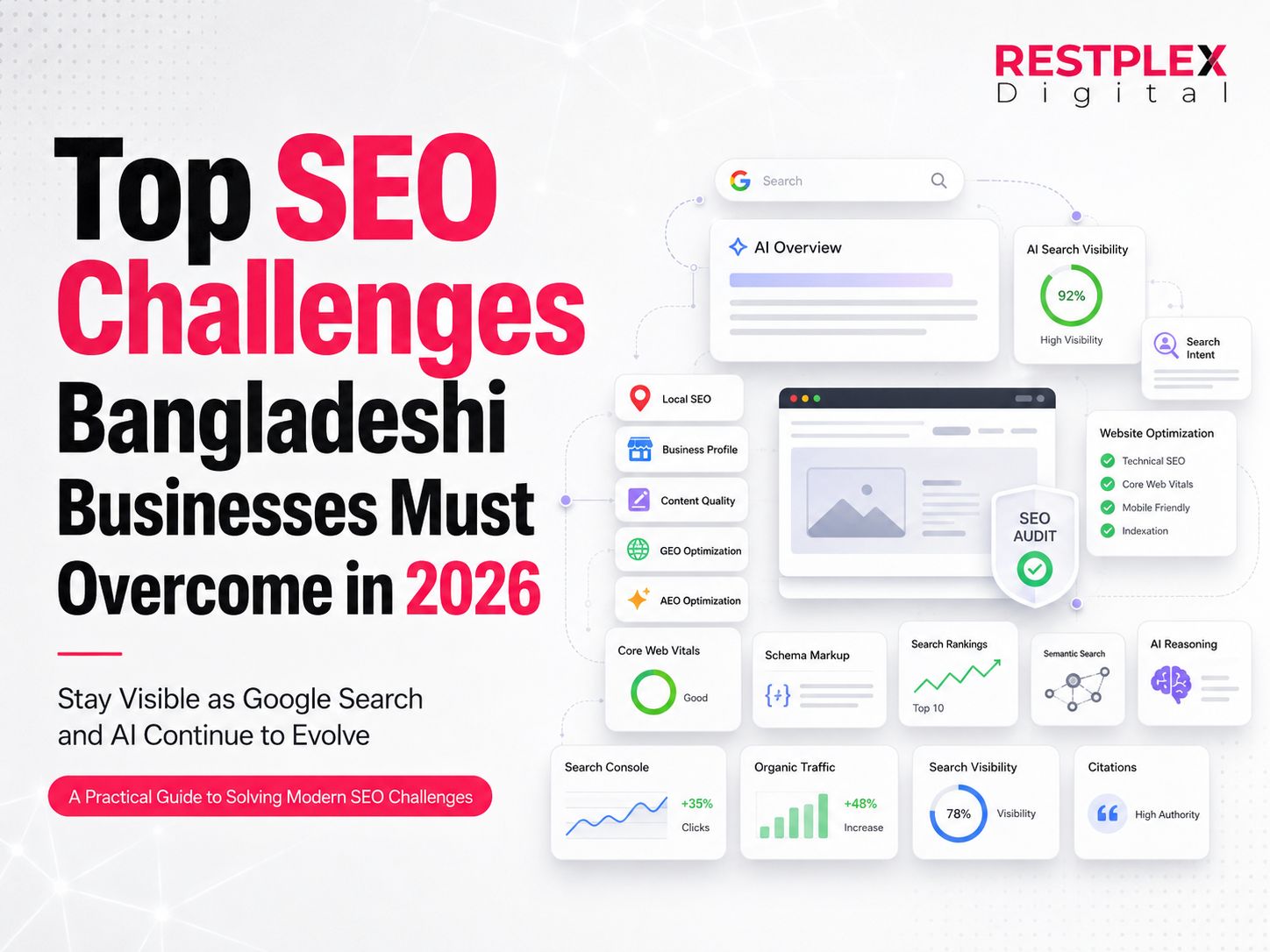
Bangladesh’s digital economy is growing fast, but the SEO challenges Bangladeshi businesses face in 2026 are growing just as quickly. Internet users passed 82 million by late 2025, according to DataReportal, and the country’s e-commerce market is on track to cross 5 to 6 billion US dollars this year. Growing demand does not automatically turn into search visibility.
Businesses trying to rank on Google in 2026 are up against problems that barely existed five years ago: patchy mobile infrastructure outside Dhaka, a search market split between Bangla and English, an AI-driven results page that answers questions before anyone clicks a link, and a local SEO agency market crowded with “guaranteed #1 ranking” claims that are hard to tell apart from real expertise.
This guide breaks down the SEO challenges Bangladeshi businesses actually face this year, based on current search data and the state of Google’s algorithm in 2026, plus what a realistic fix looks like for each one.
Key Takeaways
- Bangladesh’s mobile-first, speed-sensitive audience means Core Web Vitals need testing on real mobile network conditions, not office WiFi
- Bangla, English, and Romanized Bangla queries all carry real search volume and need separate keyword research
- An unclaimed or incomplete Google Business Profile is often the single biggest local SEO gap
- AI Overviews and AI Mode now shape a large share of search outcomes, so citation inside an AI answer matters alongside classic rankings
- FAQ rich results were deprecated in May 2026; FAQ content still matters for AI extraction, the schema-for-snippets tactic does not
- Verifiable data and transparent reporting separate genuine SEO expertise from “guaranteed #1 ranking” sales pitches
- E-commerce SEO succeeds or fails partly on trust signals both Google and shoppers look for: real reviews, clear policies, verified schema
- Consistent, modest content output beats sporadic bursts for SMEs working with limited budgets
1. A Mobile-First Market With Uneven Infrastructure
Most Bangladeshi search traffic happens on a phone, often over a mobile connection slower and less consistent than what a lot of standard SEO advice assumes. That gap between assumption and reality is the first challenge, and it shows up directly in Core Web Vitals scores.
Median mobile download speeds in Bangladesh sit around 37 Mbps, well below what businesses in more developed digital markets are used to designing for, and speeds vary sharply between Dhaka and rural districts. Recent estimates put rural internet access at roughly 49 percent against about 78 percent in urban areas. A website built and tested only in Dhaka on office WiFi will behave very differently for a customer in Rangpur on a patchy 4G connection.
Google has indexed mobile-first since 2018, and Core Web Vitals (Largest Contentful Paint, Interaction to Next Paint, Cumulative Layout Shift) are baseline ranking inputs now, not extras. Bangladeshi sites often lose points here because of unoptimized product images, render-blocking scripts, and shared hosting that struggles under traffic spikes during Eid or Pohela Boishakh sales.
Fix: Compress and lazy-load images, move to a CDN, and test Core Web Vitals against a throttled 3G/4G profile instead of office broadband. A site that loads in under 2.5 seconds on a mid-range Android phone is already ahead of most local competitors.
2. Search Behavior Split Between Bangla, English, and "Banglish"
Bangladeshi search queries are not one language. The same customer might type “ac repair Gulshan” in English, its Bangla-script equivalent, or “ac servicing gulshan dhaka” in Romanized Bangla, sometimes in the same week. Optimizing for only one version leaves real search volume on the table.
Standard keyword tools built for English-first markets under-report Bangla search volume, so relying on Ahrefs or Semrush alone will miss genuine demand. Google Keyword Planner set to Bengali, Google’s autocomplete, and Bangla “People Also Ask” boxes tend to surface far more accurate local queries. Google’s natural language handling of Bangla has also improved enough that Bangla content now regularly earns featured snippets and AI Overview citations in Bangla-language results.
Content quality matters as much here as in English. Thin, machine-translated Bangla text with awkward grammar does not rank and does not convert, since Bangladeshi readers notice the difference immediately. It takes a native Bangla writer with real subject knowledge, not a translation pass over an English draft.
Fix: Build separate keyword lists for Bangla script, Romanized Bangla, and English, and write Bangla sections with native speakers instead of translating English copy after the fact.
3. Local SEO That Stops at the Website
For most Bangladeshi businesses serving a specific city or neighborhood, the real local SEO challenge is not the website. It is an empty or poorly maintained Google Business Profile (GBP), the listing that actually powers Google Maps, the local three-pack, and increasingly, local AI Overviews.
A well-built website with no claimed GBP will lose the map pack to a weaker website that has one, especially for “near me” searches, which have climbed sharply in Bangladesh since 2020. GBP fields matter: complete business hours, real photos, accurate categories, and a steady flow of reviews all feed directly into local ranking and into what Google’s AI summarizes about a business.
Review culture adds a local twist. Many Bangladeshi customers trust a business’s Facebook page and comment section as much as its Google listing, so reviews and social proof need active management on both platforms, with NAP details (name, address, phone) kept identical across the website, GBP, Facebook, and any local directory.
Fix: Claim and fully complete the Google Business Profile, request reviews systematically after every transaction, and keep NAP data identical everywhere the business is listed.
4. AI Overviews Are Rewriting What "Ranking #1" Means
Ranking first on Google no longer guarantees a click. AI Overviews now appear on roughly half of tracked searches worldwide, up sharply from a year earlier, and Google confirmed at its May 2026 event that AI Mode has passed a billion monthly users and is merging with AI Overviews into one AI-led search experience. For many informational queries, the answer now appears directly on the results page.
This matters more, not less, for Bangladeshi SMEs with tight marketing budgets. A page that used to earn a click for ranking third or fourth might now earn nothing if an AI summary answers the question first. The businesses gaining ground are the ones being cited inside that AI answer, since brands cited in AI Overviews see meaningfully higher click-through than similarly ranked pages that go uncited.
One change worth knowing directly: Google quietly deprecated FAQ rich results in May 2026, the expandable question dropdowns that used to appear under search listings. Plenty of SEO advice still circulating, including guides aimed at Bangladeshi businesses, recommends FAQ schema purely to win that dropdown. That specific payoff is gone. FAQ content itself still earns its place, because clear question-and-answer formatting remains one of the easiest patterns for AI Overviews and chat-based search tools to extract and cite. The schema should describe genuinely useful FAQs, not chase a SERP feature that no longer exists.
Fix: Structure key pages around direct, quotable answers in the first two or three sentences of each section, keep FAQ content useful rather than schema-only, and track AI citations alongside rankings, not instead of them.
5. Telling Real SEO Expertise From "Guaranteed #1 Ranking" Noise
Search “SEO expert Bangladesh” and the results page itself proves the problem: dozens of near-identical “top 10 SEO agency” listicles, many written by the agencies they rank, promising guaranteed first-page results in a fixed number of weeks. For a business owner without an SEO background, telling a genuine specialist from a confident sales pitch is its own challenge. Google’s E-E-A-T-driven quality systems have the same problem in reverse: they increasingly discount sites with no clear author, no verifiable track record, and no real evidence behind the claims.
No one can honestly guarantee a #1 ranking. Google’s algorithm changes several times a year, and two confirmed core updates already rolled out in 2026 alone. What a credible agency can offer instead is a transparent process, realistic timelines, and reporting the business owner can verify directly against Google Search Console.
A reliable way to test this before signing a contract: ask to see real client data, not just logos and testimonials. Agencies willing to walk through actual traffic and ranking numbers, the way RESTPLEX Digital – SEO Services: Best SEO Agency in Bangladesh does with prospective clients, are far more likely to deliver than ones offering only promises.
Fix: Judge any SEO partner on verifiable data and a clear monthly reporting process, not on ranking promises or testimonial pages alone.
6. E-Commerce SEO Fighting an Old Trust Problem
Bangladesh’s e-commerce market is set to cross roughly 5 to 6 billion US dollars in 2026, growing at 12 to 20 percent a year depending on the estimate, but conversion still runs into a trust gap that SEO alone cannot fix. Years of platform collapses and delivery scams left many shoppers cautious, and cash-on-delivery remains a strong preference even as digital payments grow.
For SEO specifically, this shows up as a content and schema problem. Product pages need Product and Review schema, genuine customer photos, and specific policy details (real return windows, real delivery timelines, real refund process) rather than generic “100 percent satisfaction guaranteed” language that both shoppers and Google’s quality systems have learned to discount. Category and product pages thin on real information tend to underperform however well they are optimized technically.
Social proof carries extra weight here. Reviews, verified ratings, and genuine customer photos do double duty: they build shopper confidence and they give Google concrete evidence of an active, trustworthy business, which matters for E-E-A-T evaluation on commercial pages.
Fix: Add Product and Review schema with real ratings, publish specific and honest shipping and return policies, and surface genuine customer proof directly on product pages instead of only on a separate reviews tab.
7. A Real Skills and Budget Gap for Small Businesses
Most Bangladeshi SMEs run marketing on a tight budget, and SEO competes directly against paid ads and day-to-day operations for that budget. A full-time in-house SEO hire is expensive relative to typical SME revenue, and a single junior hire rarely covers technical SEO, content, and local SEO all at once.
The result is a common pattern: a business either does no SEO at all, or hires the cheapest available freelancer and gets thin, generic content with no real strategy behind it. Both paths waste money over an 18-month horizon, since SEO compounds and a false start often costs more to undo than to do properly the first time.
A middle path works for most SMEs: a focused technical audit and Google Business Profile setup first, since these are the highest-return, lowest-cost fixes, then a lean, consistent content schedule of two or three genuinely useful posts a month rather than a burst of ten thin ones.
Fix: Prioritize technical fixes and local SEO first since they are the cheapest wins, then commit to a small but consistent content cadence instead of one-off bursts.
8. Keeping Up Without Overreacting to Every Update
Google confirmed two core updates in 2026 already, in March and May, plus a spam update that rolled out in under 20 hours, the fastest on record. For a business owner already stretched thin, tracking every algorithm change is its own burden, and reacting to each one with sudden site-wide changes usually does more harm than good.
The safer approach is to separate signal from noise. Google’s own guidance after a core update is to wait roughly a week past the rollout’s completion before drawing conclusions, since rankings fluctuate during the rollout itself. A real quality problem shows up as a gradual decline over months. An algorithm event shows a sharp, dated step followed by a new stable pattern.
Fix: Check the Google Search Status Dashboard when traffic shifts, wait for a completed rollout before reacting, and default to improving genuine content quality and E-E-A-T signals rather than chasing each individual update.
Conclusion
None of these challenges are unique to one industry or one city, and none require an unlimited budget to fix. Fixing the highest-impact items first, mobile speed, a complete Google Business Profile, and content structured for direct answers, moves the needle faster than trying to fix everything at once.
What changes in 2026 is the ceiling. AI-driven search, a maturing e-commerce market, and a growing base of internet users mean the businesses that get the fundamentals right this year build an advantage that gets harder to catch up to every quarter that passes. For businesses that want a second pair of expert eyes on where to start, RESTPLEX Digital – SEO Services: Best SEO Agency in Bangladesh offers a straightforward audit as a starting point, no long-term contract required.
Frequently Asked Questions (FAQs)
A: Pricing varies widely, but a focused local SEO package (GBP setup, technical audit, basic content) typically sits at the lower end of the market, while full-scope campaigns targeting competitive national keywords cost significantly more. Get a clear scope and monthly deliverables in writing before comparing prices between agencies.
A: Local SEO improvements like a completed Google Business Profile can show movement within 4 to 8 weeks. Competitive organic rankings from content and technical SEO typically take 4 to 6 months to show meaningful traffic growth, longer in crowded niches like e-commerce or finance.
A: Yes, but the goal has partly shifted from "rank first" to "get cited." Businesses that structure content around clear, direct answers and maintain strong E-E-A-T signals are the ones AI systems pull from, and organic search still drives most of the informational and B2B traffic that never touches an AI summary.
A: It depends on the customer base. A business serving mostly local, non-English-speaking customers should prioritize Bangla and Banglish keyword coverage first. A business targeting urban professionals, international clients, or English-dominant e-commerce categories can lead with English and add Bangla coverage as it scales.
Share
Article by

Mehedi Hasan Juwel
Digital Marketing Strategist
Related Posts
Not Sure Where Your SEO Stands?
Get a free, no-obligation SEO audit from RESTPLEX Digital and find out exactly what’s holding your rankings back in 2026.