

AI Search Optimization Services: A Practical Guide to AEO and GEO
- July 15, 2026
Introduction
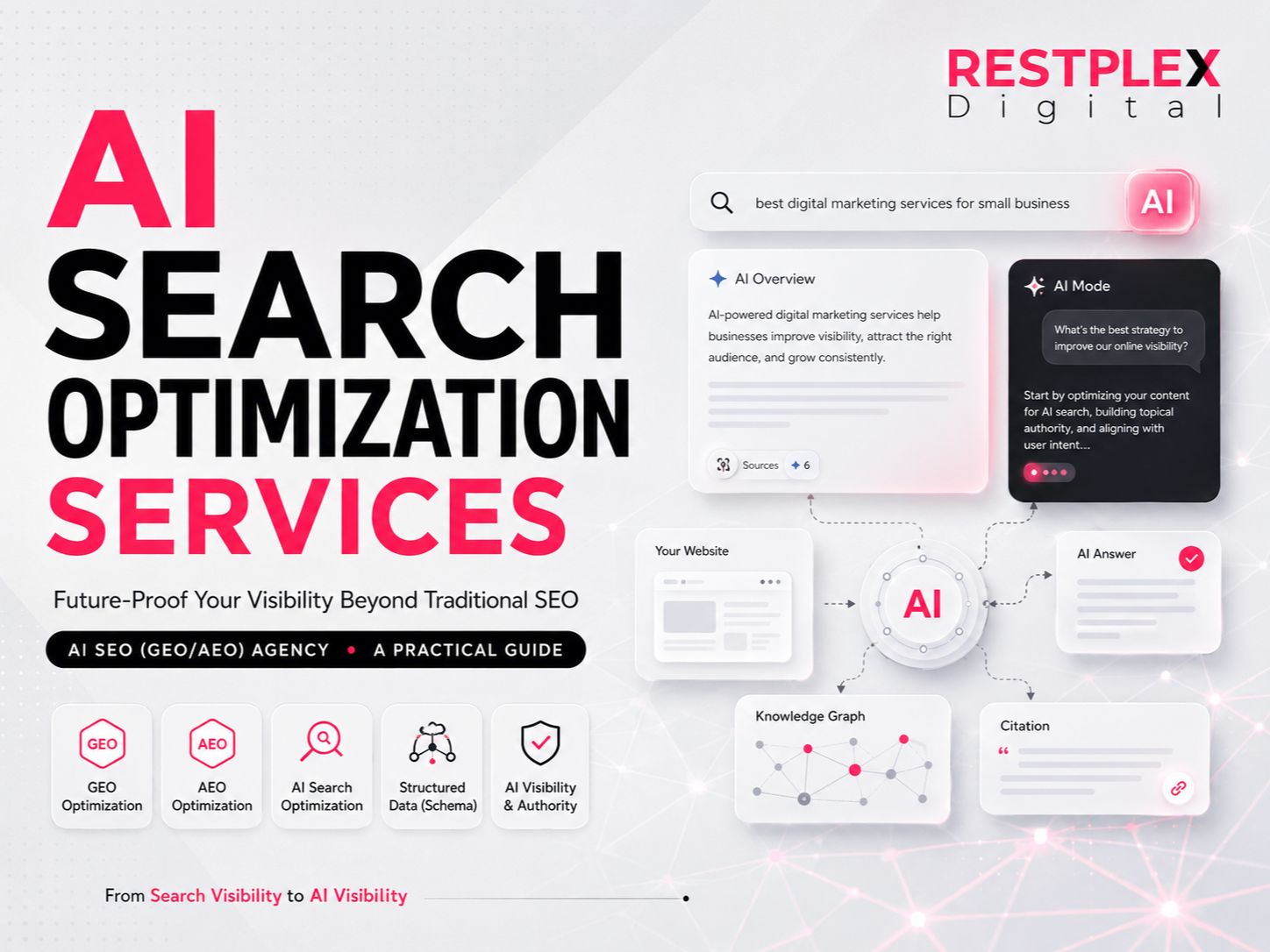
Google is no longer the only place people ask questions. ChatGPT, Perplexity, Gemini, and Google’s own AI Overviews now answer millions of queries directly, often with no click to any website at all. AI search optimization services exist to make sure your brand is the one these systems name, cite, and recommend, not a competitor.
This guide covers what AI search optimization actually involves, how AEO and GEO differ from traditional SEO, and what a real optimization engagement should include before you hire anyone to run one. None of this means abandoning what already works. It means extending it to a new set of gatekeepers.
What Is AI Search Optimization?
AI search optimization is the practice of structuring a website and its content so AI systems, including Google AI Overviews, ChatGPT, Perplexity, and Gemini, can find it, understand it, and cite it in a generated answer. It combines two related disciplines: Answer Engine Optimization (AEO) and Generative Engine Optimization (GEO).
AEO focuses on getting pulled into direct-answer formats: featured snippets, voice search results, and the answer box at the top of a search page. GEO focuses specifically on generative AI tools, the chat-based systems that write out a full response and decide, mid-generation, which sources to name.
Neither replaces traditional SEO. Both build on it. Every AI platform still needs to find, crawl, and parse your content before it can cite you, so the technical and content fundamentals of SEO stay the starting point, not a separate track.
AEO vs. GEO vs. Traditional SEO
The three disciplines share a foundation but reward slightly different things.
| Dimension | Traditional SEO | AEO | GEO |
|---|---|---|---|
| Primary goal | Rank in organic search results | Get featured in direct-answer boxes | Get cited inside AI-generated answers |
| Main platforms | Google and Bing organic listings | Featured snippets, voice assistants | ChatGPT, Perplexity, Gemini, Claude |
| Success metric | Rankings, organic clicks | Snippet ownership, voice answer share | Citation frequency, share of AI voice |
| Content format | Keyword-targeted pages | Direct-answer paragraphs, FAQs | Entity-dense, source-worthy content |
| Key technique | Backlinks, on-page keywords | Structured Q&A, schema markup | Structured data, third-party mentions, freshness |
A page built for AEO or GEO still needs the crawlability, site speed, and authority signals that traditional SEO has always required. None of these disciplines work in isolation.
Why This Matters Now
A growing share of research and comparison queries now get answered fully inside the AI response itself, with no click needed to reach the underlying sources. Most of those citations trace back to third-party pages, not brand-owned websites, which changes where the optimization work actually needs to happen.
Ranking well on Google does not guarantee an AI citation either. Research from Ahrefs comparing citations across ChatGPT, Gemini, and Copilot found that only around 12 percent of the URLs those tools cited also appeared in Google’s own top 10 results for the same query. For any brand that depends on search for new customers, that gap will not show up in a normal rank-tracking report.
How AI Search Engines Actually Choose What to Cite
Most agency pages describe this step in vague terms. Here is what the current research actually shows.
The process runs in four stages: a platform interprets the query, retrieves candidate documents, ranks them by structural trust signals rather than backlinks alone, then extracts and synthesizes the clearest facts it can lift cleanly. A page that buries its answer in dense paragraphs with nothing clear near the top often gets skipped, even if it ranks well in Google.
Each platform also behaves differently. A 2026 academic analysis of more than 21,000 AI citations across three platforms found real gaps in how each one sources an answer:
| Platform | Avg. sources cited per answer | What it rewards |
|---|---|---|
| ChatGPT | About 7 | Depth per source: it extracts roughly four times more content from each citation than the platform average |
| Google AI Overview | About 12 | Broad topical coverage, drawing from a wider pool than its own organic rankings alone would suggest |
| Perplexity | About 16 | Breadth over depth, casting the widest net of the three |
Retrieval is not the same as citation, either. Research reported by Search Engine Land found that in ChatGPT’s browse mode, only around 15 percent of the pages it actually retrieved made it into the final cited answer. Getting fetched proves a page is relevant. It says nothing about whether the model trusts it enough to attach a claim to that source by name.
What a Real AI Search Optimization Service Should Include
A service built for this space, not a rebranded SEO package with a new label, should cover:
- An AI visibility audit across ChatGPT, Perplexity, Gemini, and Google AI Overviews, showing where you already appear and where a competitor sits instead
- Entity and schema markup, structured data that gives AI systems a clean, machine-readable version of your facts
- Content restructured for extraction: direct answers in the first 40 to 60 words of a section, FAQs, comparison tables, and clear headings
- New content built for genuine gaps, not a rewrite of whatever already sits in the top five search results
- Third-party and earned-mention building, since most AI citations trace back to independent coverage rather than owned pages
- Ongoing citation tracking, since each platform’s citation behavior shifts often enough that a one-time project goes stale within months
Each of these should show up as a real deliverable in a proposal, not just a line in a sales deck.
How RESTPLEX Digital Approaches AI Search Optimization
RESTPLEX Digital – Best SEO AEO GEO Marketing Agency – Generative Engine Optimization Services builds every engagement around one question first: which sources is each AI platform already pulling from for your topic, and why isn’t your site one of them yet?
That starts with a platform-by-platform audit rather than a single generic visibility score. From there, the work splits into three tracks: fixing the technical and schema layer so machines can parse the site cleanly, restructuring or building content around the direct-answer format each platform rewards, and tracking citation frequency over time instead of stopping after one audit. Since most citations trace back to third-party sources, part of the work also focuses on earned mentions and coverage a brand cannot generate from its own site alone.
How to Choose an AEO/GEO Agency
Before signing with anyone, ask:
- What is the actual process, not just the outcome being promised?
- Which AI platforms do they track and optimize for specifically? ChatGPT, Perplexity, and Google AI Overviews each reward different things.
- How do they measure citation frequency, not just keyword rankings?
- Are they adding platform-specific work, or relabeling standard SEO deliverables as “AEO” and “GEO”?
A vague answer to any of these questions is itself useful information.
Conclusion
AI search optimization is not a rebrand of SEO. It is what happens when SEO fundamentals meet a new set of gatekeepers, each with its own rules for what gets cited and what gets ignored. Getting there takes a technical audit, content built for extraction, and tracking that does not stop after the first report.
If you’re ready to see exactly where your brand stands across ChatGPT, Gemini, and Google AI Overviews, RESTPLEX Digital – Best SEO AEO GEO Marketing Agency – Generative Engine Optimization Services can start with a free audit of where you’re being cited today, and where you’re not.
Frequently Asked Questions (FAQs)
A: AEO stands for Answer Engine Optimization, the practice of structuring content so it gets pulled into direct answers like featured snippets and voice search results, not just ranked as a standard listing.
A: AEO targets direct-answer formats on search engines, mainly Google. GEO targets generative AI tools like ChatGPT and Perplexity that write a full response and choose sources mid-generation. The two overlap but need some different tactics.
A: Yes. Every AI platform still relies on crawlable, well-structured content as its starting material. SEO builds the technical foundation that AEO and GEO sit on top of.
A: Many brands see measurable changes in citation frequency within 60 to 90 days, since AI platforms often refresh sources faster than classic search indexing. Consistent citation across topics typically takes two quarters or more.
A: Pricing varies by scope, but most GEO and AEO work runs alongside an existing SEO or content budget rather than replacing it. Ask for a breakdown of audit, technical, content, and monitoring costs separately.
A: Yes. AI systems weight structural clarity and topical depth heavily, so a small, well-organized site can out-cite a larger competitor running thin or outdated content on the same topic.
A: Through citation frequency and share of voice, tracked by running target queries repeatedly across platforms and logging which sources get named, rather than through organic rankings alone.
Share
Article by

Mehedi Hasan Juwel
Digital Marketing Strategist
Related Posts

Start Winning AI Citations
Partner with RESTPLEX Digital to become the source ChatGPT, Gemini, and Google AI Overviews actually cite.