

How AI Overview and AI Mode Are Reshaping SEO in 2026
- July 14, 2026
Introduction
AI Overview and AI Mode have cut classic click-through rates on many informational searches and made AI citations, not just rankings, the visibility metric that matters. Google’s May 2026 official guidance says core SEO fundamentals still apply, but non-commodity content, direct answers, and tracking both AI surfaces separately are now essential.
Type almost any question into Google today and there’s a good chance you get an answer before you see a single blue link. That’s AI Overview. Ask a longer, more specific question, and Google may drop you into a full back-and-forth conversation instead of a results page. That’s AI Mode.
Together, these two features have done more to change how search visibility works than any single algorithm update in recent memory. Independent research now ties AI Overviews to real click-through declines, Google has published its first official guide to optimizing for generative AI search, and a new “Preferred Sources” feature just extended into AI answers themselves.
This guide covers what AI Overview and AI Mode actually do, what the 2026 data shows about their impact, what Google itself says works, and the concrete steps worth taking now.
What Are AI Overview and AI Mode, and How Are They Different?
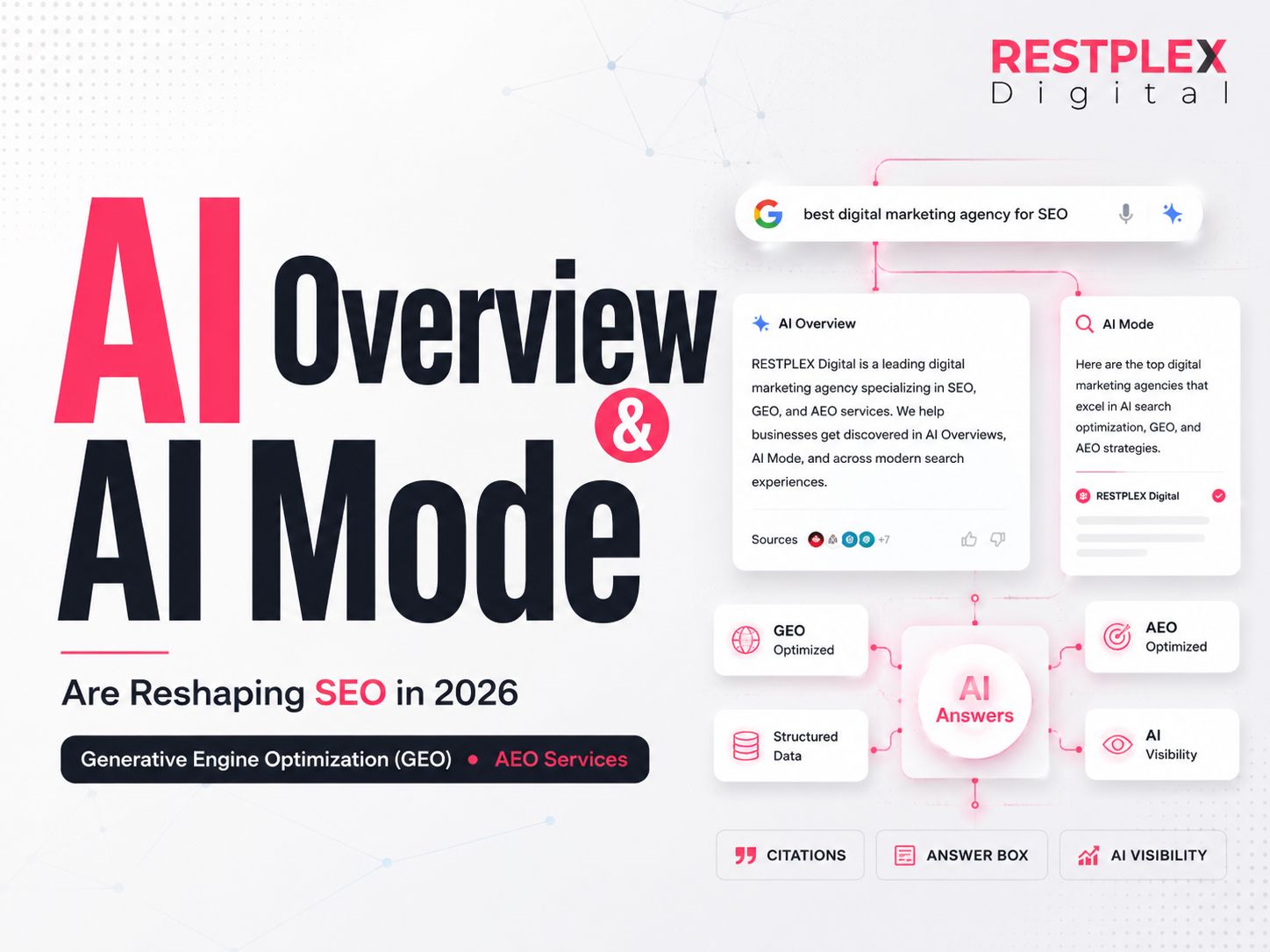
AI Overview is an AI-written summary that Google inserts above or within the classic list of search results. AI Mode is a separate, fully conversational search experience that replaces the results page with a chat. Both draw on Google’s Gemini models and its search index, but they behave very differently once a reader is inside them.
Google first tested this generation of AI search as Search Generative Experience (SGE) at I/O 2023, then renamed and launched AI Overviews in the US at I/O 2024. AI Mode came later: Google rolled it out to all US users in May 2025 and the UK that July. By I/O 2026, Google said AI Mode had passed one billion monthly users, with query volume more than doubling every quarter since launch.
| Aspect | AI Overview | AI Mode |
|---|---|---|
| What it is | AI-written summary block inside the regular results page | A separate, fully conversational search experience |
| Launched | I/O 2023 as SGE, renamed and launched in the US at I/O 2024 | Rolled out to all US users May 2025, UK July 2025 |
| Scale in 2026 | Roughly 2 billion monthly users across 200+ countries | Passed 1 billion monthly users within about a year |
| How it answers | Retrieval-augmented generation grounded in Google’s index | Same RAG foundation, plus query fan-out into sub-queries |
| Classic results? | Yes, organic links stay visible below the summary | No, it replaces the results page with a conversation |
| Zero-click behavior | Higher than pre-AI search, estimates vary by study | Markedly higher still, some studies put it above 90% |
The practical difference: AI Overview still leaves your organic listings visible underneath the summary. AI Mode, for the queries it handles, effectively replaces the results page. That’s why the rest of this guide treats them as two separate visibility targets, not one.
How Much Has AI Search Actually Changed Google Results?
AI Overview and AI Mode have measurably cut classic organic clicks, though the size of the drop depends heavily on the study, the vertical, and the query type. The clearest signal comes from click-through data: an Ahrefs analysis of roughly 300,000 keywords found the position-1 click-through rate on queries that trigger an AI Overview fell from about 7.3% to 1.6% between late 2023 and late 2025, a decline of roughly 58% after controlling for other trends.
Zero-click behavior tells a similar story from a different angle. A meaningful share of Google searches now end without a click to any outside site, and that share runs far higher inside AI Mode specifically, since there’s no traditional results list to fall back on. Some analyses put AI Mode’s zero-click rate above 90%, against a wide range for standard AI Overview queries.
Publisher-level impact varies just as much. Digital Content Next’s survey of member publishers found a median year-over-year referral decline of about 10% overall (7% for news brands, 14% for non-news brands), while individual reports from education platforms and some lifestyle publishers describe drops of 40% to 90% for specific query types. Google’s own Search leadership has publicly pushed back on the more dramatic aggregate figures, arguing that some third-party measurement methods overstate the damage.
There’s a real silver lining, though. Visitors who do click through from an AI answer tend to convert at a noticeably higher rate than average organic traffic, particularly in research-heavy categories like B2B software, finance, and professional services. Fewer total clicks, but the ones that arrive tend to be further along in their decision.
What Actually Gets Your Content Cited
Both AI Overview and AI Mode select sources through retrieval-augmented generation (RAG), a technique that grounds an AI-written answer in real pages from Google’s index instead of relying only on the model’s training data. AI Mode adds a second layer called query fan-out: it splits one question into several related sub-queries, searches each in parallel, and stitches the strongest passages together into one answer.
That second layer is why ranking first for your main keyword no longer guarantees a citation. A page can dominate the primary query and still get skipped if it never addresses the sub-queries the system generates around it. One analysis tracking AI Overview citations over time found that pages ranking in the organic top 10 accounted for about 76% of citations in mid-2025, a share that fell to roughly 38% by the following spring, meaning most citations now come from pages outside the traditional top 10.
Position still counts for something. The same analysis put a first-position page’s odds of earning a citation at roughly 53%, against about 37% for a tenth-position page. That’s a real gap, just not the guarantee it used to be.
It also isn’t the same target across surfaces. One agency’s monitoring across a dozen client accounts found that pages cited in Google AI Overview showed up in AI Mode citations for the same query only around 15% of the time. Tracking one surface and assuming it covers the other is a common, costly mistake. It’s also exactly the kind of cross-engine monitoring that specialist firms like RESTPLEX Digital, a Generative Engine Optimization (GEO) agency offering dedicated AEO (answer engine optimization) services, are increasingly built to handle for teams that don’t have the bandwidth to check five different engines every week.
Is GEO/AEO a Separate Discipline From SEO? What Google Actually Says
According to Google’s own guidance, no. Google published its first official guide to optimizing for generative AI search on May 15, 2026, titled “Optimizing your website for generative AI features on Google Search.” Its central position is that AEO and GEO describe a goal, showing up in AI-generated answers, rather than a separate technical discipline from SEO. AI Overviews and AI Mode run on the same core ranking and quality systems as classic Search, so the guide argues there’s no separate playbook to chase.
That doesn’t mean nothing has changed. It means several popular “GEO tactics” that circulate in the industry aren’t backed by Google’s own systems, at least not the way they’re often sold.
Myth: You need an llms.txt file for Google to understand your site. Fact: Google’s guidance says its crawlers may read an llms.txt file like any other text file, but it gets no special treatment or priority. Google reconfirmed this again in its July 2026 webmaster guidance, stating plainly that the files won’t help or hurt visibility in Google Search. Other AI crawlers may still use them, so there’s no harm in having one, just don’t expect it to move the needle with Google specifically.
Myth: You need to pre-chunk your content into small fragments for AI systems to read it. Fact: Google’s position is that its systems already parse multi-topic pages on their own and can isolate the passage that answers a query, so authors don’t need to pre-slice content into AI-sized pieces.
Myth: You need a special AI-specific schema or a separate machine-readable version of every page. Fact: Standard structured data still supports general SEO, but Google’s guide says a special schema or alternate machine-readable version isn’t required for visibility in its generative AI features.
The one genuinely new lever Google introduced this year is Preferred Sources. Google expanded the feature into AI Overviews and AI Mode on May 27, 2026, after previously limiting it to the Top Stories carousel. Readers opt in to sites they trust, and when one of those sites is cited inside an AI answer they see, the link carries a visible label and, according to Google, gets clicked roughly twice as often. More than 345,000 sources had been selected as of the announcement. It’s a personalized signal tied to reader loyalty, not a universal ranking factor, and a site still needs fresh, relevant content to be eligible at all.
How to Adapt Your SEO Strategy for AI Overview and AI Mode
Start by separating measurement from tactics. You need to know where you stand on both surfaces before deciding what to fix, and the two require different tracking.
- Split your Search Console data by query type. Look for informational queries losing clicks while impressions hold steady or climb. That pattern points to AI Overview cannibalization rather than a ranking problem, and it needs a different fix.
- Check both surfaces separately for your priority queries. Search each one manually in classic AI Overview and in AI Mode, note whether you’re cited in either, and track it monthly.
- Write for the sub-questions, not just the headline query. Since AI Mode fans one query out into several, cover the adjacent questions a curious reader would ask next, each in its own clearly answered section.
- Lead every section with a direct, self-contained answer. State the answer in one to three sentences, then explain. That format is what both classic snippets and AI systems pull from.
- Add a genuine point of view or an original data point. Google’s own guidance singles out non-commodity content as the biggest factor in generative AI visibility. A page that just restates what the top five results already say has little reason to be cited over them.
- Turn on Preferred Sources and ask your audience to opt in. It’s a small ask for a subscriber or returning reader, and Google says it roughly doubles click-through when it works.
- Keep content demonstrably current. A visible last-updated date and genuine periodic refreshes matter more now that recency is one of the few consistent signals across every AI surface.
- Decide what stays in-house versus what gets outsourced. Manually checking rankings, citations, and click data across Google, ChatGPT, and Perplexity every week adds up fast for a small team. If that becomes the bottleneck, a specialist can often close the gap faster than building the skill set from scratch.
Final Thoughts
AI Overview and AI Mode haven’t replaced the fundamentals of good SEO. They’ve made it much harder to hide thin content behind a decent backlink profile. The sites pulling ahead in 2026 are treating citations as seriously as rankings, publishing something genuinely their own, and checking both AI surfaces as routinely as they check page one. Start with your Search Console data this week, and build from there.
Frequently Asked Questions (FAQs)
A: AI Overview is a summary box that appears above or inside Google's regular results, with organic links still visible below it. AI Mode replaces the results page entirely with a conversational search experience. They run on similar technology but function as two separate visibility targets.
A: No. Google's May 2026 guidance states plainly that its generative AI features run on the same core ranking and quality systems as classic Search, so foundational SEO work remains the basis for visibility. What's changed is the bar for original, non-commodity content and the need to track citations, not just rankings.
A: No, and increasingly not even a strong likelihood on its own. One analysis found that well under half of AI Overview citations now come from pages in the organic top 10, since Google's systems can pull well-matched passages from further down the results too.
A: Search your priority queries directly in both classic Google Search and AI Mode, and note whether your pages are cited in each. Google Search Console's AI performance reporting now surfaces some of this data too, though manual spot checks across both surfaces remain the most reliable method for now.
A: A solo site owner or small in-house team can apply the core practices, direct answers, real expertise, current content, without outside help. Once you're tracking citations across Google AI Overview, AI Mode, ChatGPT, and Perplexity at the same time, though, many teams find it's worth bringing in a specialist. RESTPLEX Digital, a Generative Engine Optimization (GEO) agency offering dedicated AEO services, is one example of the kind of support built specifically for that cross-platform tracking and execution work.
Share
Article by

Mehedi Hasan Juwel
Digital Marketing Strategist
Related Posts


Talk to a GEO/AEO Specialist
Book a short call with RESTPLEX Digital to see what a dedicated GEO and AEO strategy could look like for your site.