
How to Get Found in ChatGPT and Perplexity
- May 15, 2026
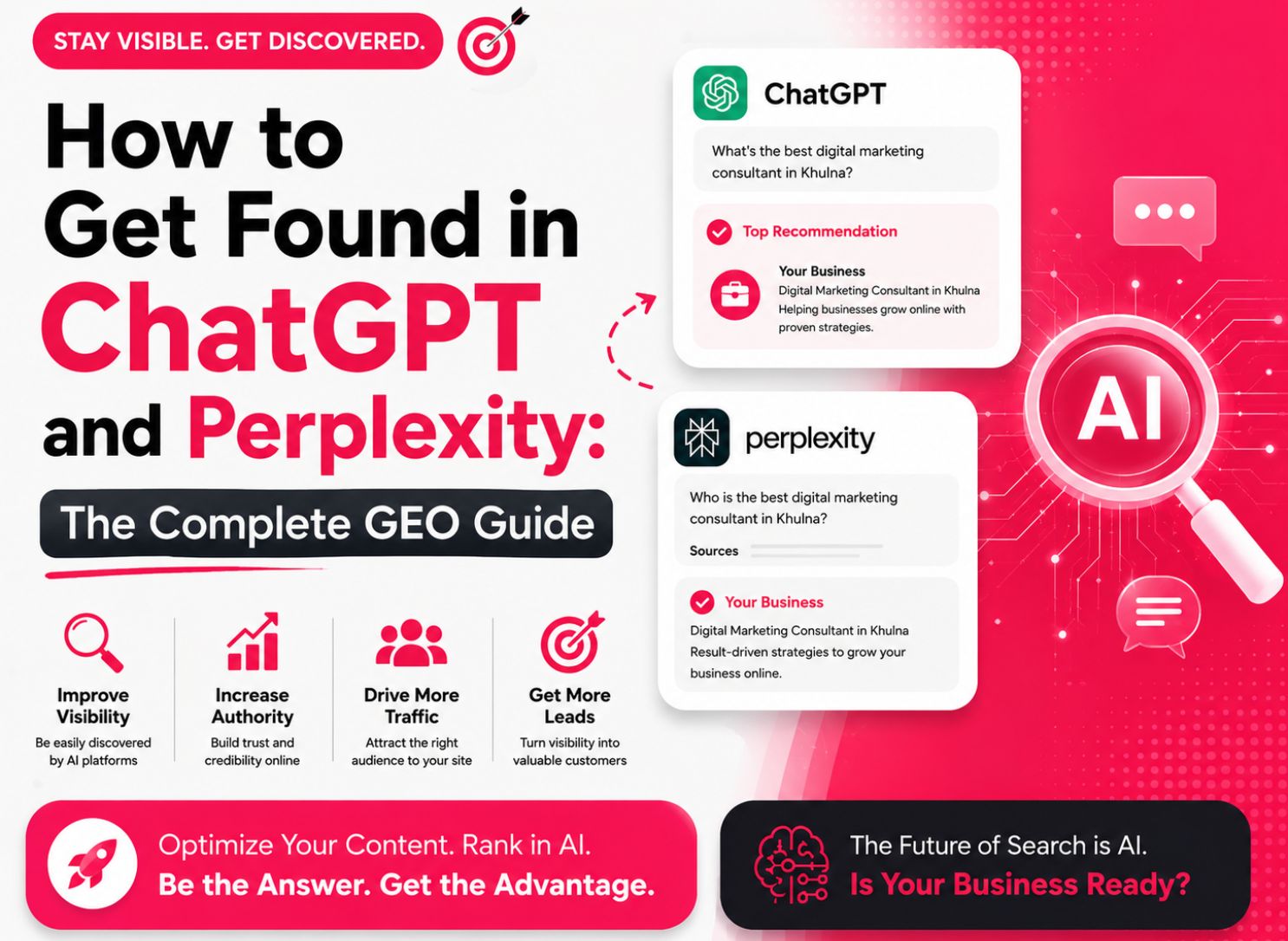
How to Appear in ChatGPT and Perplexity Results
People aren’t just Googling things anymore. They’re asking ChatGPT full questions, using Perplexity to summarize research, trusting AI answers over a page of blue links.
If your brand isn’t showing up in those answers, your Google ranking doesn’t help you. AI search runs on different rules — and if you haven’t thought about those rules yet, this is the place to start.
What "Getting Found in AI Search" Actually Means
When you rank on Google, someone sees your link and clicks it. When you get found in AI search, the AI pulls from your content to answer someone’s question — sometimes without linking back to you at all.
This is called Generative Engine Optimization (GEO), sometimes Answer Engine Optimization (AEO). The goal isn’t a ranking position. It’s becoming the source the AI cites.
Traditional SEO optimizes for clicks from a list of links. GEO optimizes for citations inside a synthesized answer. Those require genuinely different strategies — and most brands are still only doing the first one.
Why It Matters
ChatGPT has over 800 million weekly active users. Perplexity processed 780 million queries in a single month in 2025 — up 239% year over year. Nearly 90% of B2B buyers now use AI tools during their purchasing journey, and many start their research in ChatGPT or Perplexity rather than Google.
If that’s where your audience is going, your content needs to meet them there.
How ChatGPT and Perplexity Pick Their Sources
These platforms work differently, and it’s worth knowing how.
ChatGPT draws from training data plus live Bing search. It favors encyclopedic, comprehensive content from established domains — Wikipedia, major publications, recognized industry sources. If your brand isn’t already visible across the web, ChatGPT may pass you over, even if your content is good.
Perplexity is more citation-friendly. It shows live citations and pulls heavily from community platforms. Nearly half its top cited sources come from Reddit, with YouTube close behind. You don’t need high domain authority here — you need genuine presence in the right places.
Google AI Overviews sits between the two. It still weights traditional signals like backlinks and domain authority but generates a summary on top. Pages that appear tend to answer not just the main question but the follow-ups.
Step 1: Find Out Where You Stand
Before doing anything else, run a quick audit. Open ChatGPT, Perplexity, and Google. Search the questions your customers would actually ask about your product or service. Write down what you see.
Are you mentioned anywhere? Who’s getting cited instead? How are competitors described?
If you’re invisible, that’s your starting point. If you’re mentioned but inaccurately, that’s a different problem. Either way, this audit is worth twenty minutes of your time before you change anything else.
Step 2: Structure Your Content So AI Can Actually Use It
AI systems are built to summarize. They pull from content that’s direct and organized. Dense, meandering writing gets skipped.
Put the answer first. Don’t ease in. Put your main point in the opening 40–60 words and explain it after. A sentence like “To get found in ChatGPT, your content needs to be structured, authoritative, and answer-first” is something an AI can extract. Three paragraphs of scene-setting before you get to the point is not.
Certain formats work better. FAQ sections with tight question-and-answer pairs. Numbered how-to steps. Comparison tables. Short definitions. TL;DR summaries. These make it easy for AI to find what it needs.
Write short paragraphs — two or three sentences each. Write headings that actually describe the section content, not vague labels like “Our Approach.”
Step 3: Build Credibility Beyond Your Website
AI systems look at what the whole web says about you, not just your own site.
E-E-A-T — Experience, Expertise, Authoritativeness, Trustworthiness — is how AI systems think about credibility now. In practice, that means: detailed author bios on every article (credentials, experience, links to other profiles), citing your sources when you reference data, and publishing original research when you can. Case studies, surveys, unique stats — that content becomes highly citable. AI platforms treat it as a source, not a citation.
Step 4: Show Up Off Your Own Site
Brand mentions across the web correlate three times more strongly with AI visibility than backlinks do. That surprised me when I first read it — but it makes sense. If you only exist on your own site, AI systems have very little to go on.
Reddit is heavily cited by Perplexity. YouTube is a strong source across all major AI platforms. LinkedIn gets referenced regularly for B2B topics. Genuine participation in Reddit threads in your niche now has SEO value in a way it simply didn’t before. So do helpful YouTube videos, even simple ones.
Reviews on G2, Trustpilot, and Google Business Profile also send trust signals. Being mentioned in industry roundups helps AI systems place your brand next to known competitors.
Step 5: Check the Technical Basics
Many websites accidentally block AI crawlers in their robots.txt file. Check yours — make sure GPTBot, PerplexityBot, and other AI crawlers aren’t blocked.
Beyond that: fast load times, mobile-friendly design, HTTPS. And schema markup, which tells AI exactly what your content is. FAQ schema, Article schema, HowTo schema — these aren’t optional anymore. On WordPress, Rank Math or Yoast handle most of this automatically.
Step 6: Keep Content Fresh
Perplexity prioritizes recent information. Visibility can drop within days of publication if content isn’t updated or referenced by new sources.
You don’t need to rewrite constantly. Adding a new stat, updating an example to the current year, or adding a “Last updated” note near the top makes a real difference. A light refresh every few months is enough to stay competitive.
Quick Platform Reference
Platform | Favors | Best Content Type | Key Signal |
ChatGPT | Established domains, comprehensive content | Guides, definitions | Domain authority, web-wide mentions |
Perplexity | Recency, community sources | FAQ content, updated posts | Reddit/YouTube presence, freshness |
Google AI Overviews | Top-ranking pages, thorough answers | Long-form, structured content | Traditional SEO + schema |
How to Know If It's Working
AI visibility doesn’t surface cleanly in standard analytics, but you can track it. Check referral traffic in GA4 — sessions from ChatGPT or Perplexity sometimes appear in referral or direct channels. Run monthly AI audits: search your brand and key topics and note whether you’re appearing more often and more accurately. Track brand mentions with Google Alerts, Mention, or Semrush.
Mistakes That'll Hold You Back
Blocking AI crawlers in robots.txt. Writing without a clear answer upfront. No author bio or trust signals. Ignoring Reddit, YouTube, and LinkedIn entirely. No FAQ section or structured data on key pages. Publishing and never revisiting. Assuming Google rankings cover AI visibility automatically. These are the most common things I see, and most are fixable in an afternoon.
To Wrap Up
AI search is already here. ChatGPT, Perplexity, Google AI Overviews — your audience uses them now, and that’s not reversing.
The underlying work isn’t that different from what makes content good in general: write clearly, demonstrate expertise, be useful, and be present in more than one place. GEO just makes those things matter more.
Start with the audit. Fix the technical basics. Structure your content for answers. Build presence off your site. Keep things updated.
Do that consistently and you’ll be findable where your audience is actually looking.
Frequently Asked Questions (FAQs)
SEO gets you ranked in a list of links. GEO gets your content cited inside an AI-generated answer. The optimization strategies are genuinely different.
Well-structured, authoritative content with a clear answer upfront. Presence on Reddit, YouTube, and LinkedIn. Schema markup. And make sure AI crawlers can reach your site.
Somewhat — Perplexity pulls from live web results, so ranking on Google makes you easier to find. But Perplexity cites Reddit and YouTube heavily, which standard SEO doesn't prioritize.
Technical fixes like schema and crawler access can move the needle within weeks. Building multi-platform authority takes a few months.
Yes — especially in Perplexity. Genuine Reddit participation and useful YouTube content can get a small brand real visibility without high domain authority.
Share
Article by

Mehedi Hasan Juwel
Digital Marketing Strategist, SEO Expert & WordPress Developer