
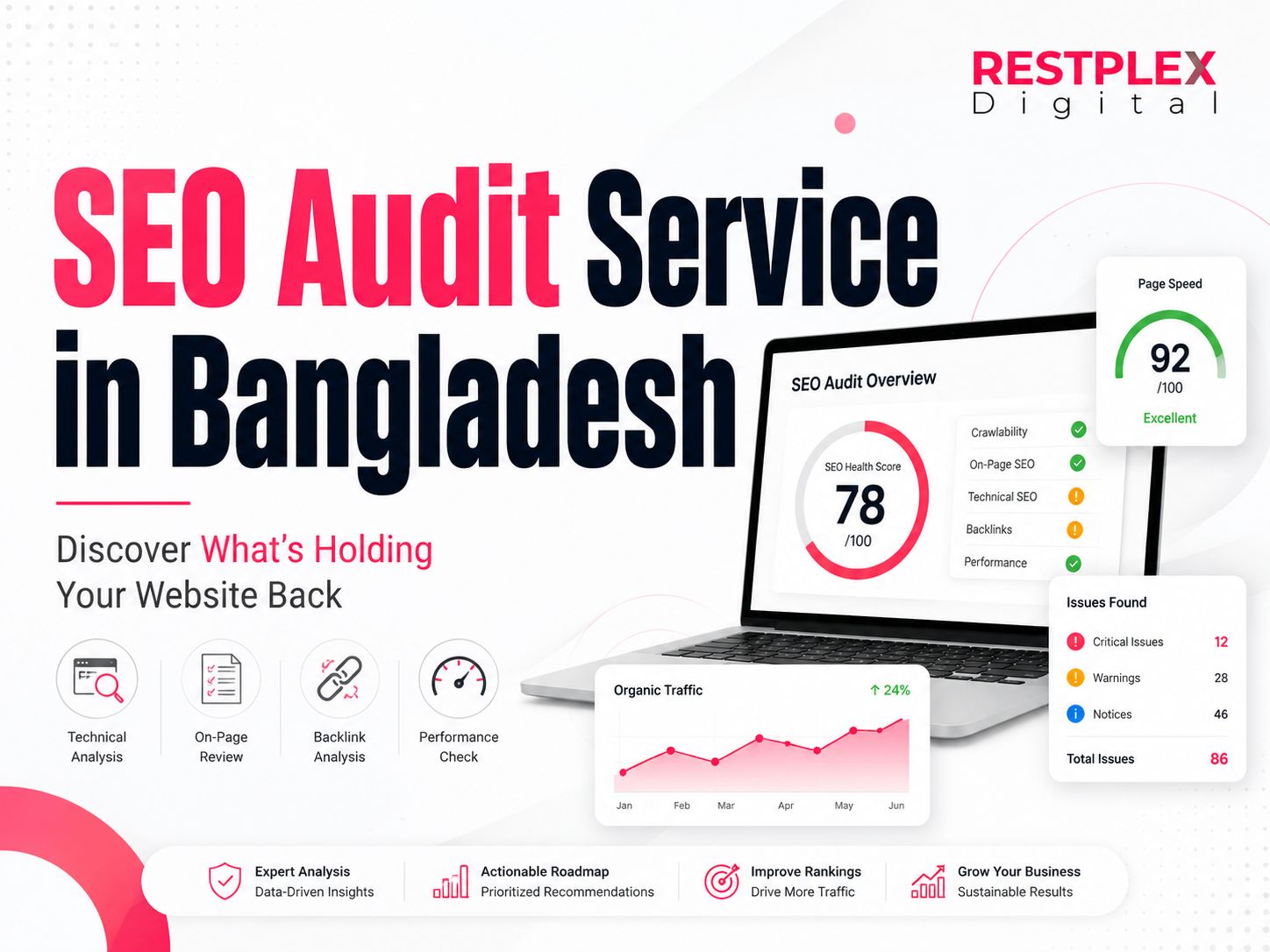
SEO Audit Service in Bangladesh: Discover What's Holding Your Website Back
- June 28, 2026
Introduction
Your website may look professional, but appearance alone doesn’t determine how well it performs in Google Search. Hidden technical issues, weak content, poor internal linking, indexing problems, and missed optimization opportunities can all reduce your visibility—even when your products or services are excellent.
Without a comprehensive SEO audit, improving rankings often becomes a process of trial and error. A professional SEO audit provides a structured evaluation of your website’s technical health, content quality, user experience, and search performance, helping you identify what is limiting your organic growth and prioritize the improvements that matter most.
Whether you operate a local business, an eCommerce store, or a growing company in Bangladesh, an SEO audit creates a clear roadmap for increasing search visibility, attracting qualified visitors, and supporting long-term business growth.
Key Takeaways
- An SEO audit evaluates your website’s technical health, content quality, user experience, and overall search performance.
- A professional audit helps uncover indexing, crawlability, content, and authority issues that may reduce organic visibility.
- Modern SEO audits include Core Web Vitals, structured data, internal linking, content quality, backlink analysis, and technical performance.
- Regular audits help your website stay aligned with evolving Google Search guidance and changing user expectations.
- An audit delivers a prioritized action plan that supports sustainable improvements in rankings, traffic, and conversions rather than relying on guesswork.
What Is an SEO Audit and Why Does It Matter?
What Is an SEO Audit?
An SEO audit is a comprehensive evaluation of your website to identify technical, content, and authority-related factors that influence its visibility in organic search results. It examines how effectively search engines can crawl, understand, index, and rank your website while also assessing whether your pages satisfy user intent.
Rather than focusing on a single issue, a professional SEO audit reviews the complete health of your website, including:
- Technical SEO
- Content quality and relevance
- On-page optimization
- Internal linking
- Website architecture
- Page experience
- Core Web Vitals
- Structured data implementation
- Backlink quality
- Local SEO signals (where applicable)
The outcome is a prioritized action plan that identifies opportunities to improve visibility, usability, and long-term organic performance.
Why Is an SEO Audit Important?
Search engines continuously refine how they evaluate websites. While Google’s core objective remains the same—helping users find the most helpful and reliable information—the factors influencing visibility continue to evolve as websites, user behavior, and search technologies change.
An SEO audit helps you identify issues before they significantly affect your organic performance. Common findings include:
- Pages that cannot be indexed correctly
- Broken internal links
- Duplicate or thin content
- Missing or poorly optimized metadata
- Slow-loading pages
- Weak information architecture
- Poor mobile usability
- Missing structured data
- Opportunities to improve topical coverage and search intent alignment
Addressing these issues improves not only search visibility but also overall website usability, accessibility, and conversion potential.
Why SEO Audits Matter for Businesses in Bangladesh
As more businesses across Bangladesh invest in digital marketing, competition for organic search visibility continues to increase. Customers are comparing businesses online before making purchasing decisions, making strong search performance an important competitive advantage.
A professional SEO audit helps businesses:
- Identify technical barriers affecting organic visibility
- Improve local and national search performance
- Enhance website usability across mobile and desktop devices
- Strengthen content relevance for target audiences
- Build a stronger foundation for long-term SEO growth
For businesses targeting local customers, an audit can also uncover opportunities to improve local SEO signals such as location pages, business information consistency, and Google Business Profile optimization.
SEO Audit vs. Automated Website Scan
Many free SEO tools generate automated reports within minutes. While these reports are useful for identifying basic technical issues, they rarely provide the context needed to prioritize improvements effectively.
| Automated SEO Scan | Professional SEO Audit |
|---|---|
| Identifies basic technical issues | Evaluates technical, content, UX, and authority together |
| Relies primarily on automated checks | Combines professional analysis with advanced SEO tools |
| Limited business context | Considers business goals, competitors, and search intent |
| Generic recommendations | Prioritized, actionable improvement roadmap |
| Minimal competitor insights | Includes market and competitor analysis where appropriate |
A comprehensive SEO audit combines industry-standard tools with expert analysis to explain not only what should be fixed, but also why it matters and which improvements should be prioritized first.
What Can You Expect After an SEO Audit?
An SEO audit does not guarantee higher rankings. Instead, it identifies obstacles that may be limiting your website’s performance and provides evidence-based recommendations for improvement.
Depending on your website’s condition and the implementation of recommended changes, an audit may help improve:
- Crawlability and indexability
- Organic search visibility
- Website speed and page experience
- Content quality and topical authority
- Internal linking efficiency
- User engagement
- Lead generation and conversion opportunities
The greatest value comes from implementing audit recommendations as part of an ongoing SEO strategy rather than treating the audit as a one-time task.
Learn More About Our Complete Step-by-Step SEO Audit Checklist
What Does an SEO Audit Include?
A professional SEO audit is much more than a checklist of technical errors. It provides a comprehensive evaluation of your website’s ability to be discovered, understood, and trusted by both search engines and users.
Rather than focusing on a single ranking factor, a modern SEO audit examines multiple areas that work together to influence your website’s organic visibility. These include technical SEO, on-page optimization, content quality, user experience, website architecture, structured data, internal linking, and backlink authority.
The objective is not simply to identify problems but to prioritize improvements based on their potential impact on search performance and business goals.
Technical SEO Audit
Technical SEO forms the foundation of every successful website. If search engines cannot efficiently crawl, render, understand, or index your pages, even exceptional content may struggle to achieve strong visibility.
A technical SEO audit typically evaluates the following areas:
Crawlability and Indexability
The audit determines whether search engines can properly discover and index your important pages.
Common checks include:
- Crawl errors reported in Google Search Console
- XML sitemap accuracy
- robots.txt configuration
- Robots meta directives
- Canonical URL implementation
- Orphan pages
- Duplicate URLs
- Redirect chains and redirect loops
- Broken internal links
- HTTP status codes (404, 410, 500, and other server responses)
Improving crawlability and indexability helps search engines understand which pages should appear in search results and prevents valuable content from being overlooked.
Website Architecture
A well-organized website helps both users and search engines navigate your content more efficiently.
An SEO audit reviews:
- Site hierarchy
- URL structure
- Navigation consistency
- Category organization
- Internal page depth
- Breadcrumb implementation
- Pagination where applicable
A logical site architecture improves content discoverability and supports stronger internal linking.
Core Web Vitals and Page Experience
Website performance directly influences user satisfaction and can affect search visibility.
Modern SEO audits measure Core Web Vitals, including:
- Largest Contentful Paint (LCP)
- Interaction to Next Paint (INP)
- Cumulative Layout Shift (CLS)
Additional performance factors include:
- Server response times
- Render-blocking resources
- Image optimization
- JavaScript efficiency
- CSS optimization
- Browser caching
- Compression
- Mobile responsiveness
Rather than optimizing only for speed scores, a professional audit focuses on creating a faster, more stable, and more responsive experience for real users.
Mobile Usability
Since most users browse on mobile devices, websites must perform consistently across different screen sizes.
The audit evaluates:
- Responsive layouts
- Touch-friendly navigation
- Font readability
- Button spacing
- Mobile loading speed
- Viewport configuration
- User experience on smartphones and tablets
Improving mobile usability benefits both visitors and search performance.
HTTPS and Website Security
Website trust is another important evaluation area.
An audit typically reviews:
- HTTPS implementation
- Mixed content issues
- Security certificate validity
- Secure redirects
- Basic security-related technical concerns that may affect user confidence
While security itself is broader than SEO, maintaining a secure website supports a better user experience and helps build trust.
Structured Data and Schema Markup
Structured data helps search engines better understand your content and may make your pages eligible for enhanced search features.
Depending on the website, an audit may recommend Schema.org markup such as:
- Organization
- LocalBusiness
- Service
- Article
- FAQPage
- BreadcrumbList
- Product
- Review
- WebPage
The audit also verifies whether structured data is implemented correctly and free of validation errors.
On-Page SEO Audit
On-page SEO focuses on how individual pages communicate their relevance and value to both users and search engines.
A professional audit evaluates every significant page rather than relying solely on homepage analysis.
Key review areas include:
Metadata Optimization
The audit examines:
- Title tags
- Meta descriptions
- Heading hierarchy
- URL optimization
- Open Graph tags where applicable
Metadata should accurately describe page content while encouraging users to click from search results.
Content Quality
Modern SEO places strong emphasis on creating genuinely helpful content.
An audit reviews whether pages demonstrate:
- Originality
- Accuracy
- Topical depth
- Clarity
- Completeness
- Freshness
- Readability
- Search intent alignment
It also identifies:
- Thin content
- Duplicate content
- Outdated information
- Keyword cannibalization
- Missing topic coverage
Rather than focusing on keyword density, modern SEO emphasizes comprehensive topical coverage and natural language.
Search Intent Alignment
Ranking well requires more than targeting keywords.
Each important page should satisfy the user’s underlying search intent.
An SEO audit evaluates whether content effectively answers the questions users are actually trying to solve, whether they are seeking information, comparing services, or preparing to make a purchase.
Improving intent alignment often increases both rankings and conversion rates.
Semantic SEO
Search engines increasingly understand topics, entities, and relationships instead of relying on exact-match keywords.
A semantic SEO review examines whether content naturally covers:
- Related concepts
- Supporting subtopics
- Industry terminology
- Frequently asked questions
- Entity relationships
This creates more comprehensive content that better addresses user needs while increasing topical authority.
Internal Linking
Internal links help distribute authority across your website while guiding visitors toward relevant content.
The audit evaluates:
- Internal link opportunities
- Anchor text diversity
- Orphan pages
- Link depth
- Topic clusters
- Pillar page relationships
- Navigation consistency
A strong internal linking strategy improves discoverability and helps search engines better understand content relationships.
Image Optimization
Images contribute to both user experience and search visibility.
The audit reviews:
- Descriptive file names
- Alt text
- Compression
- Image dimensions
- Lazy loading
- Modern image formats where appropriate
Optimized images improve accessibility while supporting overall website performance.
Off-Page SEO and Backlink Audit
Off-page SEO evaluates the external signals that contribute to your website’s authority and credibility.
Rather than focusing only on backlink quantity, a professional audit assesses overall backlink quality and relevance.
Typical review areas include:
- Referring domains
- Link quality
- Link relevance
- Anchor text profile
- Lost backlinks
- Newly acquired backlinks
- Competitor backlink comparisons
- Potential spam patterns
- Manual action risks, if any
Because Google has become increasingly effective at evaluating link quality, earning relevant and trustworthy backlinks is generally more valuable than acquiring large volumes of low-quality links.
Local SEO Audit (When Applicable)
For businesses serving customers in Bangladesh, local SEO can significantly influence visibility.
A local SEO audit may evaluate:
- Google Business Profile optimization
- Business information consistency
- Local landing pages
- Location-specific content
- Local citations
- Customer reviews
- Local schema markup
- Map visibility
- Local keyword targeting
These factors help businesses improve visibility for geographically relevant searches.
Content and Topical Authority Audit
Modern SEO extends beyond individual pages.
A content audit evaluates whether your website demonstrates sufficient expertise across your subject area.
Areas reviewed include:
- Content gaps
- Topic clusters
- Supporting articles
- Content freshness
- Duplicate coverage
- Authoritativeness
- Opportunities for deeper educational content
Building topical authority helps search engines better understand your expertise while providing greater value to users.
Competitor SEO Analysis
Understanding your competitors provides valuable context for your own SEO strategy.
An audit may compare:
- Keyword coverage
- Content quality
- Backlink profiles
- Internal linking
- Technical implementation
- Search visibility
- Featured snippet opportunities
- AI answer visibility
- Local SEO performance
These insights help prioritize improvements based on realistic competitive opportunities rather than assumptions.
What You Receive After a Professional SEO Audit
A high-quality SEO audit should provide more than a list of issues.
You should receive a prioritized action plan that includes:
- Issues identified
- Why each issue matters
- Recommended solutions
- Expected impact
- Priority level
- Implementation guidance
- Opportunities for future optimization
This roadmap enables businesses to focus first on the improvements that are most likely to enhance search visibility, user experience, and long-term organic growth.
Why Businesses in Bangladesh Need Regular SEO Audits
Whether you run a small local business, a growing eCommerce store, or an established enterprise, your website is one of your most valuable digital assets. However, websites constantly evolve. New pages are published, products change, plugins are updated, competitors improve their SEO, and search behavior shifts over time.
Without regular reviews, even a well-optimized website can gradually develop technical issues or content gaps that reduce its visibility in organic search.
A professional SEO audit helps identify these issues early, allowing you to make informed improvements before they have a significant impact on traffic or conversions.
Increasing Competition in Organic Search
Businesses across Bangladesh are investing more heavily in digital marketing and SEO than ever before. As competition grows, achieving and maintaining strong rankings requires more than simply publishing content or adding keywords.
An SEO audit helps you understand:
- How your website compares with competitors
- Which pages have the greatest opportunity for improvement
- Where your competitors may be outperforming you
- Which technical or content issues deserve immediate attention
Rather than relying on assumptions, an audit provides data-driven insights that support better decision-making.
Search Algorithms Continue to Evolve
Google continuously refines its search systems to improve the quality and relevance of search results. While most updates are incremental, changes in search technology, user expectations, and content evaluation mean that SEO should be viewed as an ongoing process rather than a one-time project.
Regular SEO audits help ensure your website continues to align with current best practices by reviewing:
- Technical health
- Content quality
- Search intent alignment
- Website performance
- Structured data implementation
- Internal linking
- Mobile usability
- User experience
Maintaining your website over time is often more effective than waiting until rankings decline before taking action.
Mobile Experience Is Critical
A significant proportion of searches in Bangladesh are performed on smartphones. Visitors expect websites to load quickly, display correctly, and provide a seamless browsing experience across all devices.
An SEO audit evaluates mobile performance by reviewing:
- Responsive layouts
- Touch-friendly navigation
- Core Web Vitals
- Mobile page speed
- Readability
- Interactive elements
Improving the mobile experience benefits both users and long-term organic performance.
Better SEO Supports Better Business Outcomes
SEO is not solely about increasing rankings. A well-optimized website also helps improve the overall customer experience.
By resolving technical issues, improving navigation, strengthening content, and aligning pages with user intent, businesses can often achieve benefits such as:
- Higher-quality organic traffic
- Improved user engagement
- Increased enquiry and lead opportunities
- Better conversion potential
- Stronger online credibility
- More sustainable long-term growth
How to Choose the Right SEO Audit Service in Bangladesh
Not every SEO audit provides the same level of insight. Some providers rely almost entirely on automated tools, while others combine advanced software with professional analysis and practical recommendations.
When evaluating an SEO audit service, consider the following factors.
1. Comprehensive Website Analysis
A quality audit should evaluate every major aspect of SEO rather than focusing on a single area.
Look for audits that include:
- Technical SEO
- On-page optimization
- Content quality
- Internal linking
- Website architecture
- Structured data
- Core Web Vitals
- Backlink profile
- Local SEO (where relevant)
- Competitor analysis
Comprehensive audits provide a clearer understanding of how different factors work together.
2. Manual Review Alongside Professional Tools
SEO platforms can identify many technical issues, but they cannot fully evaluate search intent, content quality, business objectives, or user experience.
Experienced SEO professionals combine industry-standard tools with manual analysis to identify opportunities that automated reports often overlook.
Common tools may include:
- Google Search Console
- Google Analytics 4
- Google PageSpeed Insights
- Screaming Frog SEO Spider
- Ahrefs
- Semrush
- Sitebulb
The value comes from interpreting the data—not simply generating reports.
3. Prioritized Recommendations
An effective audit should explain:
- What was found
- Why it matters
- How to fix it
- Which issues should be addressed first
Prioritized recommendations help businesses allocate resources more efficiently instead of attempting to solve every issue at once.
4. Experience Within Your Industry
Every industry has different search behavior, competition, and customer expectations.
Choosing an SEO provider familiar with your market can improve the relevance of recommendations, particularly for:
- Local businesses
- Professional services
- Healthcare
- Education
- Manufacturing
- Real estate
- eCommerce
Industry knowledge helps ensure that SEO strategies align with real business objectives rather than generic best practices.
5. Transparency and Communication
A trustworthy SEO provider should clearly explain:
- Audit scope
- Deliverables
- Timeline
- Pricing
- Limitations
- Recommended next steps
Avoid agencies that promise guaranteed rankings or unrealistic timelines, as search performance depends on many factors beyond any single optimization effort.
Questions to Ask Before Hiring an SEO Audit Agency
Before choosing an SEO partner, consider asking:
- What areas of SEO are included in the audit?
- Is the audit performed manually or primarily automated?
- Will I receive prioritized recommendations?
- Are implementation services available?
- Can you explain your audit methodology?
- Do you provide competitor analysis?
- How will success be measured after implementation?
Clear answers to these questions can help you compare providers more effectively.
What Happens During Our SEO Audit Process?
Although every website is unique, a professional SEO audit generally follows a structured process.
Step 1 – Website Discovery
Understand the business, target audience, goals, competitors, and existing website performance.
Step 2 – Technical Analysis
Review crawlability, indexability, Core Web Vitals, structured data, security, website architecture, redirects, XML sitemaps, canonicalization, and server responses.
Step 3 – Content Evaluation
Assess page quality, topical coverage, search intent alignment, duplicate content, metadata, semantic relevance, and opportunities to strengthen authority.
Step 4 – Authority Assessment
Evaluate backlink quality, referring domains, internal linking, competitor authority, and external trust signals.
Step 5 – Competitor Research
Compare keyword visibility, content strategy, technical implementation, and backlink opportunities against relevant competitors.
Step 6 – Action Plan
Prepare a prioritized roadmap outlining:
- Critical issues
- High-impact opportunities
- Medium-priority improvements
- Long-term recommendations
This structured approach enables businesses to implement changes strategically rather than attempting to address every issue simultaneously.
Common SEO Issues We Frequently Identify
While every website is different, professional audits often uncover recurring issues that limit search visibility.
Examples include:
- Important pages not indexed
- Missing or duplicate title tags
- Weak meta descriptions
- Thin or outdated content
- Poor internal linking
- Slow-loading pages
- Broken links
- Duplicate URLs
- Incorrect canonical tags
- Missing structured data
- Weak topical coverage
- Orphan pages
- Poor mobile usability
- Inconsistent heading structure
- Low-quality image optimization
Addressing these issues helps create a stronger technical and content foundation for future SEO growth.
Pros and Cons of Hiring an SEO Audit Expert
| Benefits | Considerations |
|---|---|
| Independent, objective evaluation of your website | Professional audits require an initial investment |
| Identifies technical, content, and authority issues in one review | Recommendations must be implemented to achieve results |
| Prioritizes improvements based on business impact | Larger websites may require more comprehensive analysis |
| Helps reduce unnecessary trial and error | SEO is an ongoing process rather than a one-time project |
| Supports long-term organic growth and better user experience | Results vary depending on competition, website quality, and implementation |
Top Benefits of Getting an SEO Audit in Bangladesh
A professional SEO audit delivers value far beyond identifying technical errors. It provides the insights needed to make informed decisions that strengthen both search performance and user experience.
Key benefits include:
Identify Technical Barriers
Discover crawlability, indexability, and website performance issues that may prevent important pages from appearing in search results.
Improve Content Quality
Find opportunities to strengthen topical coverage, improve readability, satisfy search intent, and remove outdated or duplicate content.
Enhance User Experience
Improve website navigation, mobile usability, accessibility, and page performance to create a better experience for visitors.
Strengthen Topical Authority
Identify content gaps and opportunities to build comprehensive resources that demonstrate expertise within your industry.
Improve Internal Linking
Create stronger relationships between related pages, helping users navigate your website while improving content discoverability.
Support Local SEO
Optimize local landing pages, business information, and location signals to improve visibility for geographically relevant searches.
Build a Long-Term SEO Strategy
Move beyond isolated optimizations by developing a prioritized roadmap that supports sustainable organic growth over time.
Make Better Business Decisions
Instead of relying on assumptions, use evidence-based recommendations to determine where your SEO investment is likely to have the greatest impact.
Common Myths About SEO Audits
Myth: An SEO audit is only necessary when rankings decline.
Reality:
Preventative audits often identify technical and content issues before they significantly affect search visibility. Regular reviews support continuous improvement rather than reactive fixes.
Myth: A single SEO audit is enough forever.
Reality:
Websites evolve over time. New content, design changes, software updates, and shifting search behavior can introduce new optimization opportunities or technical issues. Periodic audits help maintain long-term performance.
Myth: More SEO tools automatically mean a better audit.
Reality:
Professional tools are valuable, but meaningful results come from accurate interpretation and strategic recommendations rather than the number of reports generated.
Myth: SEO is only about keywords.
Reality:
Modern SEO considers many interconnected factors, including technical health, content quality, user experience, structured data, internal linking, topical authority, accessibility, and search intent satisfaction.
Myth: Technical SEO alone improves rankings.
Reality:
Technical improvements create a stronger foundation, but long-term organic growth also depends on helpful content, credibility, relevant backlinks, and an excellent user experience.
Myth: SEO audits are only useful for large companies.
Reality:
Businesses of every size can benefit from understanding how their website performs in search. Smaller websites often have fewer pages to optimize, making improvements easier to implement.
Conclusion
A professional SEO audit is one of the most valuable investments you can make in your website’s long-term success.
Rather than relying on assumptions, an audit provides a clear understanding of your website’s current performance, identifies opportunities for improvement, and creates a prioritized roadmap for sustainable growth.
Whether you’re launching a new website, expanding your digital presence, or refining an established SEO strategy, a comprehensive audit helps ensure your website is technically sound, user-friendly, and aligned with current search best practices.
When combined with thoughtful implementation, high-quality content, and ongoing optimization, an SEO audit becomes the foundation for stronger visibility, improved user experience, and sustainable organic growth.
Frequently Asked Questions (FAQs)
An SEO audit is a comprehensive evaluation of a website's technical health, content quality, user experience, internal linking, and backlink profile. Its purpose is to identify issues that may limit organic search visibility and provide a prioritized plan for improvement.
An SEO audit helps uncover technical, structural, and content-related issues that can affect how search engines crawl, index, and understand your website. Regular audits also help ensure your site continues to meet evolving search best practices while providing a better experience for visitors.
The ideal frequency depends on your website and how often it changes.
As a general guideline:
- Every 6–12 months for relatively stable websites
- Every 3–6 months for actively growing businesses
- After a website redesign or migration
- Following significant content updates
- If you notice a sustained decline in organic traffic or indexing
Regular reviews help identify issues before they become larger problems.
The timeframe depends on the size and complexity of the website.
Typical timelines include:
- Small business websites: 3–5 business days
- Medium-sized websites: 5–10 business days
- Large eCommerce or enterprise websites: one to several weeks
A thorough manual review generally requires more time than an automated scan but provides significantly more valuable insights.
SEO audit pricing varies depending on:
- Website size
- Number of pages
- Technical complexity
- Competitive landscape
- Scope of analysis
- Whether implementation support is included
Rather than choosing solely based on price, compare providers based on the depth of analysis, reporting quality, and practical recommendations.
Yes. Website owners can use tools such as Google Search Console, Google Analytics 4, and PageSpeed Insights to identify many common issues.
However, a professional audit combines multiple data sources with expert interpretation, competitor research, search intent analysis, and implementation prioritization that automated tools alone cannot provide.
No.
An SEO audit identifies opportunities and provides recommendations based on current best practices, but rankings depend on many factors, including competition, content quality, website authority, search intent alignment, and effective implementation.
Think of the audit as a roadmap rather than a guarantee.
Free tools typically focus on automated technical checks.
A professional audit also evaluates:
- Content quality
- User experience
- Internal linking
- Topical authority
- Competitor performance
- Search intent alignment
- Local SEO
- Business objectives
- Prioritized implementation recommendations
This broader analysis helps businesses make better-informed optimization decisions.
Professional SEO specialists often use a combination of industry-standard platforms, including:
- Google Search Console
- Google Analytics 4
- Google PageSpeed Insights
- Screaming Frog SEO Spider
- Ahrefs
- Semrush
- Sitebulb
- Rich Results Test
The specific toolset may vary depending on the website and project requirements.
Once the audit is finished, the next step is implementation.
Most businesses begin by resolving high-priority technical issues before improving content, internal linking, page experience, and authority-building initiatives.
Progress should then be monitored through ongoing reporting and periodic audits to measure improvement over time.
Share
Article by

Mehedi Hasan Juwel
Digital Marketing Strategist