Small Business Digital Marketing Services
- May 16, 2026
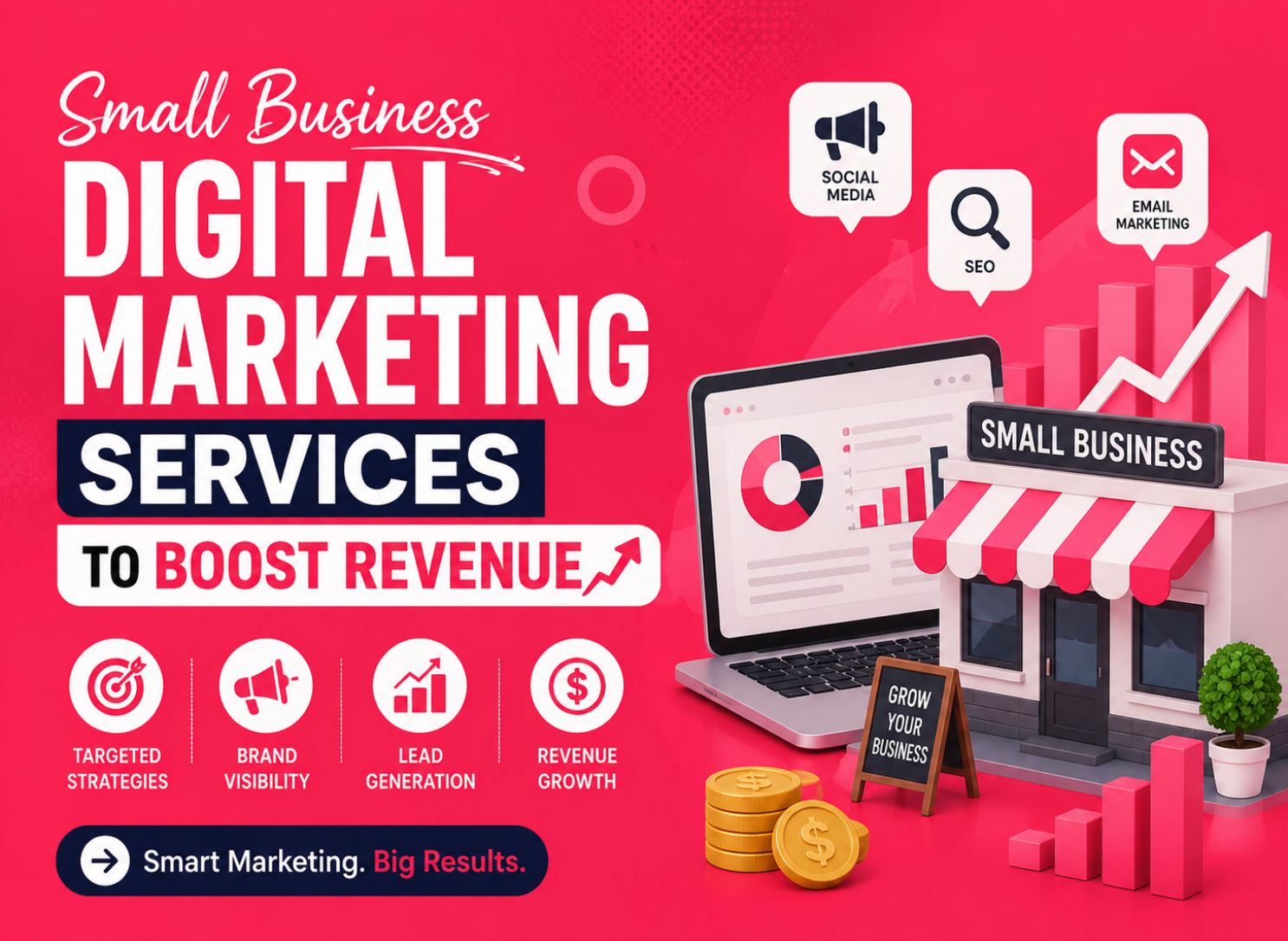
Best Digital Marketing Services for Small Business to Boost Revenue
Most small businesses lose customers online before the first conversation starts. Poor visibility, inconsistent messaging, and wasted ad spend quietly drain revenue every month. The good news: the right small business digital marketing services fix all three. This guide breaks down exactly which services move the needle, how to pick them, and what results to expect.
Key Takeaways
- SEO, PPC, social media, content, and email are the five core services that drive SMB revenue.
- Small businesses with a defined digital marketing strategy generate measurably more leads than those without one.
- Budget does not determine success. Targeting and channel fit do.
- Hiring an agency vs. going in-house depends on speed-to-results and internal bandwidth.
- Track ROI per channel from day one. Cut what does not convert; scale what does.
What Are Digital Marketing Services for Small Businesses?
Digital marketing services for small businesses are online strategies and tools used to attract customers, generate leads, and grow revenue without the overhead of traditional advertising. They include SEO, paid ads, social media management, content creation, email campaigns, and conversion rate optimization.
For small and medium enterprises (SMEs), the focus is on precision: reaching the right audience at the lowest possible cost per acquisition. Unlike enterprise campaigns with seven-figure budgets, SMB digital marketing succeeds through tight targeting and measurable outcomes.
7 Core Digital Marketing Services Every SMB Should Know
1. Search Engine Optimization (SEO)
SEO gets your website in front of people actively searching for what you sell. Local SEO is especially valuable for brick-and-mortar businesses — it drives foot traffic and calls from nearby customers. Most small businesses that invest in SEO see compounding returns over 6–12 months.
2. Pay-Per-Click Advertising (PPC)
Google Ads and Microsoft Advertising put your offer at the top of search results immediately. PPC works best when you have a clear offer, a landing page that converts, and a defined cost-per-lead target. Budgets as low as $500/month can generate qualified leads in competitive local markets.
3. Social Media Marketing
Facebook, Instagram, and LinkedIn give small businesses direct access to their target audience. Organic content builds trust. Paid social ads scale reach. For SMBs selling to consumers, Facebook and Instagram ads consistently deliver measurable return at manageable budgets.
4. Content Marketing
Blog posts, videos, and case studies attract and educate potential buyers before they are ready to purchase. Content also fuels SEO and social media, making it a multiplier channel. Businesses that publish consistent blog content generate up to 3x more inbound leads than those that do not.
5. Email Marketing
Email has the highest ROI of any digital channel, averaging $36 returned for every $1 spent (Litmus, 2023). For small businesses, email campaigns retain existing customers, promote offers, and drive repeat revenue — all with low overhead.
6. Local SEO and Google Business Profile
For SMEs with a physical location or service area, a fully optimized Google Business Profile generates calls, direction requests, and website visits. This is one of the fastest, lowest-cost wins available to small business owners.
7. Conversion Rate Optimization (CRO)
Getting traffic is only half the job. CRO improves the percentage of visitors who become paying customers through A/B testing, better landing pages, and cleaner checkout flows. A 1% improvement in conversion rate can add thousands in monthly revenue without increasing ad spend.
How to Choose the Right Digital Marketing Services for Your SME
Start with your revenue goal, not the channel. Work backward:
- Define your target customer — who they are, where they search, what they respond to.
- Pick 2–3 channels that match their behavior. Do not spread budget across everything.
- Set a 90-day KPI for each channel: leads, cost per lead, or revenue attributed.
- Review monthly. Cut underperformers. Reinvest in what works.
Most SMBs see the fastest results from a combination of Local SEO + Google Ads in the first 90 days, followed by content and email to build long-term retention.
Pros and Cons of Hiring a Digital Marketing Agency for Small Business
| Pros | Cons |
|---|---|
| Immediate access to specialists in SEO, PPC, and content | Monthly retainer costs can strain tight budgets |
| Faster execution than building an in-house team | Less control over day-to-day creative decisions |
| Access to premium tools without direct subscription costs | Some agencies use cookie-cutter strategies, not custom ones |
| Objective, data-driven reporting on what is working | Onboarding takes 2–4 weeks before campaigns launch |
| Scales up or down based on business needs | Relationship-dependent — quality varies by account manager |
Top Benefits of Small Business Digital Marketing Services
- Measurable ROI. Every click, lead, and sale is trackable. You know exactly what each marketing dollar generates.
- Cost efficiency. Digital channels cost far less than print, radio, or TV — and reach a more targeted audience.
- 24/7 visibility. Your SEO rankings and paid ads work while you sleep, generating leads outside business hours.
- Audience targeting precision. Target by location, age, income, search behavior, and purchase intent — not just demographics.
- Faster customer acquisition. PPC and paid social can generate leads within 24–48 hours of launch.
- Brand credibility. Consistent content, positive reviews, and active social presence build trust with first-time visitors.
- Competitive reach. Small businesses can now compete with larger players on Google and social platforms with the right strategy.
- Customer retention. Email and retargeting keep existing customers engaged, increasing lifetime value without high re-acquisition costs.
- Scalable growth. Start small, prove ROI, then scale budgets as revenue grows. Digital marketing grows with your business.
- Real-time adjustments. Unlike print ads, digital campaigns can be paused, edited, or redirected in minutes based on live data.
Common Myths About Digital Marketing for Small Businesses Debunked
Myth: Digital marketing is only for big companies with large budgets.
Fact: Most high-performing SMB digital marketing campaigns run on $500–$3,000/month. Targeting and strategy matter more than raw spend. A focused $1,000 Google Ads campaign often outperforms a scattered $10,000 one.
Myth: SEO shows results in weeks.
Fact: SEO is a 6–12 month investment. Businesses that expect instant ranking jumps will be disappointed. The payoff is compounding organic traffic that costs nothing per click.
Myth: Social media is free marketing.
Fact: Organic reach on Facebook and Instagram dropped below 5% for most business pages. Consistent results require a paid budget on top of organic content efforts.
Myth: A website is enough — customers will find you.
Fact: A website with no SEO, no ads, and no social presence gets zero organic traffic. Visibility requires active, ongoing marketing investment.
Myth: Email marketing is outdated.
Fact: Email consistently outperforms social media for direct conversions. With a clean list and relevant offers, email campaigns produce some of the highest returns in digital marketing.
Myth: Digital marketing is too technical for small business owners to understand.
Fact: The fundamentals are straightforward. Most agencies provide plain-English reporting. You do not need to understand the algorithm to make smart marketing decisions.
Myth: More channels always mean more results.
Fact: Spreading budget across five channels with no strategy produces weak results in all five. Two well-funded, well-targeted channels outperform five underfunded ones every time.
Conclusion
The right small business digital marketing services do not just increase visibility. They create a predictable pipeline of customers and revenue. Start with two or three channels that match your audience, measure every result, and scale what works. Whether you manage it in-house or partner with an agency, consistency and data-driven decisions separate SMBs that grow from those that stall.
Frequently Asked Questions (FAQs)
Local SEO and Google Business Profile optimization are the highest-impact, lowest-cost starting points. Once those are in place, add Google Ads for immediate lead flow and email marketing to retain early customers. Avoid spreading budget across too many channels in the first 90 days.
Most marketing benchmarks recommend allocating 7–10% of gross revenue to marketing, with 50–60% of that going to digital channels. A business earning $500,000/year might start with a $2,500–$4,000/month digital marketing budget and scale from there based on measured ROI.
PPC and paid social can generate leads within 48 hours. SEO typically takes 4–6 months for meaningful ranking improvements. Email and content marketing build returns over 6–12 months. Plan for a 90-day ramp-up on most channels before drawing conclusions.
It depends on bandwidth and budget. Agencies deliver faster results and require no hiring overhead, but cost more per month. In-house teams offer more control but take longer to build and manage. Many small businesses start with an agency and bring capabilities in-house as they grow.
Email marketing delivers the highest ROI at an average $36 per $1 spent. Local SEO is the most cost-effective for long-term organic growth. PPC delivers the fastest results for a set cost-per-lead target.
Yes. Precise targeting, local SEO, and niche content allow small businesses to outrank and out-convert larger competitors in specific geographic markets and customer segments. Size is less of an advantage online than strategy and relevance.
Share
Article by

Mehedi Hasan Juwel
Digital Marketing Strategist, SEO Expert & WordPress Developer