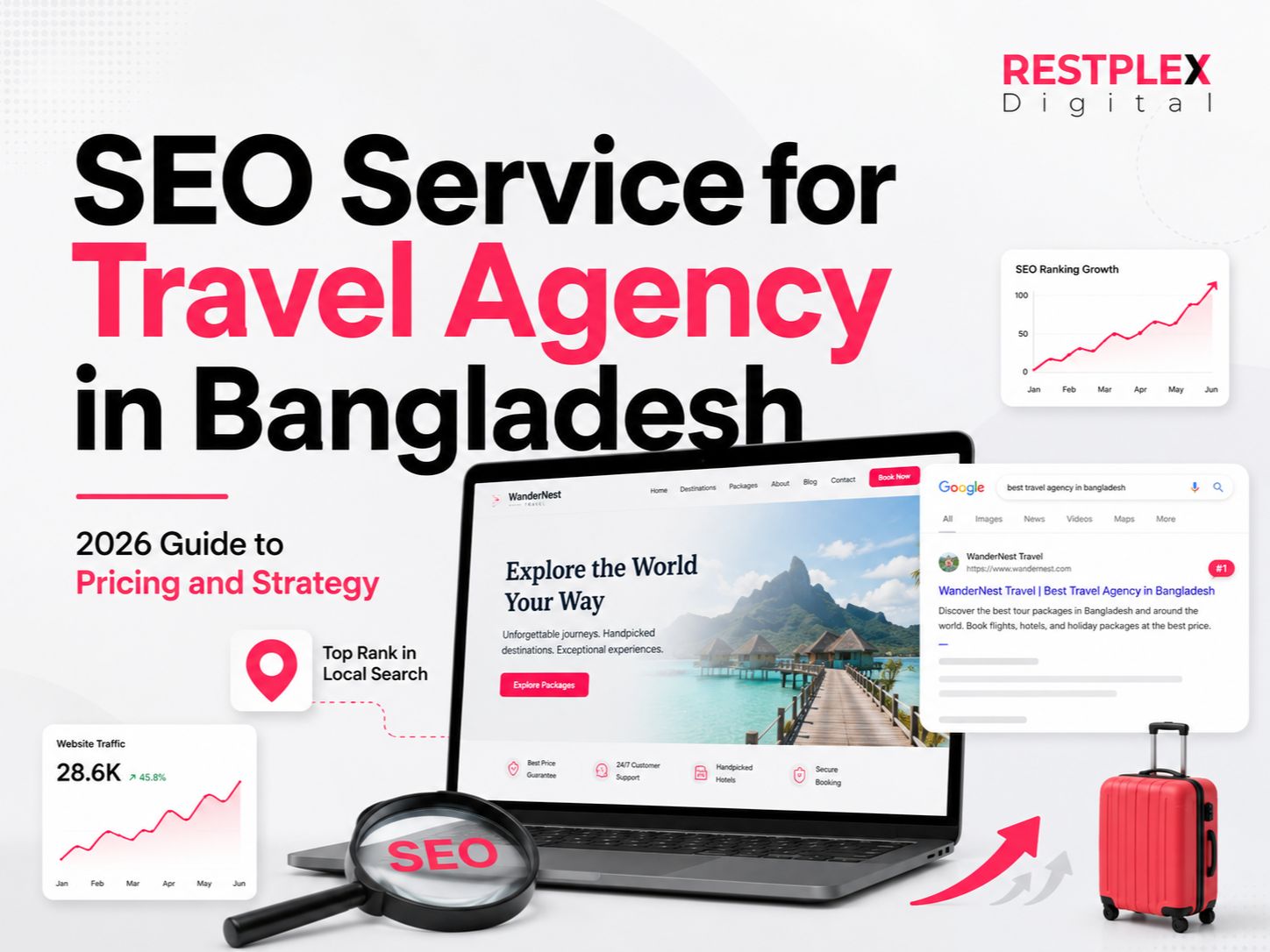
SEO Service for Travel Agency in Bangladesh
- July 6, 2026
Introduction
Bangladesh had about 83 million people online by late 2025, roughly 47% of the population, and that share keeps rising every year. Most of those people search on a phone, and a growing number type “Cox’s Bazar tour package” or “Sundarbans trip cost” straight into Google before they ever call a travel agent.
That’s the real job of an SEO service for a travel agency in Bangladesh: put your tour pages and destination content in front of a traveler at the exact moment they’re planning a trip, not after they’ve already booked through an online marketplace or clicked a Facebook ad. This guide covers what a proper SEO engagement actually includes, what it costs in Bangladesh in 2026, and where agencies waste money chasing the wrong things first.
Why Travel Agencies in Bangladesh Can't Skip SEO in 2026
Search has replaced the shopfront as where trip planning starts. Someone comparing Sylhet resorts or Bandarban trek operators does that research on Google and Facebook long before they walk into an office or call a number off a signboard.
Three shifts make search visibility harder to ignore going into 2026:
- Mobile-first research. Bangladesh now has more active mobile connections than people, and most travel searches happen on a phone screen. A slow site, or one that’s hard to read on mobile, loses the booking before an agency gets a chance to make its pitch.
- Marketplace pressure. Online travel marketplaces already rank well for generic tour keywords. An agency with no search visibility of its own is invisible next to them, and still pays a commission on every booking it captures through those platforms.
- A rising competitive floor. More agencies invest in content and technical SEO every year, so the bar for ranking on terms like “tour package Bangladesh” or “travel agency Dhaka” keeps moving up. Waiting costs agencies the compounding advantage that comes from starting early.
None of this replaces referrals or paid ads. It works underneath both, since a well-built site converts referral visits and ad clicks into bookings at a higher rate too.
What's Actually Inside an SEO Service for a Travel Agency
A real SEO engagement for a travel agency covers four areas: technical health, on-page content, local search, and off-page authority. Skipping any one of them caps what the other three can achieve.
Technical SEO
This covers page speed, mobile usability, clean indexing, and structured data (schema markup for tours, FAQs, and locations) so Google and AI search tools can read your pages correctly. It also means fixing site structure so two tour pages don’t compete against each other for the same keyword.
On-Page SEO and Content
This is keyword research built around how a traveler actually searches, tour and destination pages built around that research, and supporting content like destination guides, packing lists, and honest cost breakdowns. Internal links tie related tours together so visitors and search engines can find your full catalog.
Local SEO and Google Business Profile
For an agency with a physical office, or one serving a specific city, this means an optimized Google Business Profile, consistent business details across directories, and location-specific pages for each city you serve, such as Dhaka, Chattogram, or Sylhet.
Off-Page Authority and Link Building
Backlinks from travel blogs, tourism boards, and relevant directories signal trust to Google. A handful of links from real travel content about Cox’s Bazar or the Sundarbans carries more weight than hundreds of generic directory submissions, and Google’s spam systems increasingly discount bulk low-quality links.
How Much Does SEO Cost for a Travel Agency in Bangladesh?
Real SEO pricing in Bangladesh in 2026 sits in four rough tiers, and multiple independent 2026 pricing guides converge on similar ranges once you account for scope.
| Tier | Typical Scope | Monthly Cost (BDT) | Monthly Cost (USD) |
|---|---|---|---|
| Local, single-city agency | Google Business Profile, local keywords, basic on-page fixes | 8,000-25,000 | 70-220 |
| National tour operator | Multi-city content, technical SEO, ongoing link building | 25,000-80,000 | 220-700 |
| Enterprise or inbound tourism brand | Senior strategist, high content volume, competitive link acquisition | 80,000-400,000+ | 700-3,500+ |
| Bangladesh-based agency serving international clients | Full-service SEO priced for overseas travel brands | – | 300-1,500 |
Be cautious of anything under BDT 8,000 to 10,000 a month promising “complete SEO.” At that price, the work is usually automated backlinks and spun content, which can hurt rankings rather than build them.
For most small to mid-size travel agencies in Bangladesh, the national tier, BDT 25,000 to 80,000 a month, is the realistic starting budget. Generic tour keywords are competitive enough now that the bottom tier rarely moves rankings on its own.
SEO or Paid Ads: Where Should a Travel Agency Spend First?
Both channels matter, but they solve different problems. SEO builds a compounding base of traffic that keeps working after you stop paying for it. Paid ads buy immediate visibility that stops the moment the budget does.
| Factor | SEO | Paid Ads |
|---|---|---|
| Speed to first result | 3-6 months | Immediate |
| Cost per booking over time | Falls as rankings compound | Stays flat or rises with competition |
| Best for | Ongoing demand, like “Cox’s Bazar tour package” | Flash sales, seasonal pushes, new routes |
| Durability | Keeps producing after spend stops | Stops the moment spend stops |
Most agencies get the best return running both. Ads cover the fast win during peak booking windows like Eid or the winter season. SEO builds the base of traffic that doesn’t disappear once the ad budget runs out.
Why Bangla Content Decides Half Your Rankings
A large share of Bangladeshi travel searches happen in Bangla or mixed Bangla-English, and most agency websites only target English keywords. That gap is one of the easiest wins available right now.
A traveler dreaming about a beach trip might search “কক্সবাজার ট্যুর প্যাকেজ” rather than “Cox’s Bazar tour package.” A family planning a Sundarbans visit might type “সুন্দরবন ভ্রমণ খরচ” to check the cost before anything else. A site with no Bangla content simply never appears for either search, no matter how well its English pages rank.
Bangla content is also cheaper to produce than English, which makes this gap easier to close than most agencies assume. Run keyword research separately in both languages, since intent often differs: Bangla searches skew toward early-stage browsing and cost-checking, while English searches, especially from abroad, skew toward travelers closer to booking. Build genuine bilingual pages rather than a machine-translated copy of the English site. Machine translation reads unnatural to a native speaker and undercuts the trust this whole exercise is meant to build.
Getting Found in AI Overviews and AI Trip Planning
Travelers increasingly ask AI tools directly for itinerary advice, and Google’s AI Overviews now answer many travel questions before anyone clicks a result. An SEO service for a travel agency in 2026 has to plan for this, not only for classic blue links.
A few practical adjustments matter most:
- Open each section with a direct two-to-three sentence answer before adding detail. That’s the exact format AI Overviews and chat-based assistants pull from.
- Add structured data for tours, FAQs, and locations, since both search engines and AI systems use it to understand what a page actually offers.
- Publish specific, checkable details (real prices, real durations, real distances) instead of vague marketing language. Both AI systems and human readers trust specificity over generic claims.
- Treat being the source an AI assistant cites as seriously as a page-one ranking. More travelers now ask a chatbot for a Bangladesh itinerary before they open a search engine at all.
A Booking-Season Content Calendar for Bangladesh
Bangladeshi travel search volume moves with specific windows: Eid, the winter peak season, and Pohela Boishakh. Publishing content ahead of each window, not during it, is what actually captures the search spike.
- 8-10 weeks before Eid: family package and group tour content, since Eid travel gets planned early.
- September and October: winter destination content for Cox’s Bazar, the Sundarbans, and Sylhet, published ahead of the November-to-February peak.
- Around Pohela Boishakh in mid-April: short domestic getaway content for a shorter, closer-to-home travel window.
- Year-round: visa and travel document guides for outbound travelers, since these get searched independent of season and build steady topical authority.
How to Vet an SEO Partner Before You Sign
- Ask for exact monthly deliverables, not just a promise of “ranking improvement.”
- Ask whether content is written in-house or outsourced. Spun or unreviewed AI content without a travel-industry eye tends to underperform on Google’s newer information-gain signals.
- Confirm which schema types they implement, and make sure Google Search Console and GA4 access stays under your ownership, not the vendor’s.
- Be skeptical of guaranteed rankings. No outside party controls Google’s algorithm.
- Ask for reporting tied to inquiries and bookings, not only keyword position screenshots.
Conclusion
An SEO service for a travel agency in Bangladesh isn’t a one-time fix. It’s ongoing work across technical health, bilingual content, local presence, and now AI-visible structure, sized to what your agency can sustain monthly rather than whatever package is cheapest. Pick the tier that matches your reach, local, national, or international, budget realistically using the ranges above, and treat the first 3 to 4 months as groundwork rather than the payoff.
Agencies that stay consistent for 6 to 9 months are the ones that show up when a traveler in Dhaka, Dubai, or New York types a Bangladesh trip into Google, and increasingly, asks an AI assistant the same question before opening a search engine at all.
Frequently Asked Questions (FAQs)
A: Expect initial movement in 3 to 4 months and a real effect on traffic and bookings by 6 to 9 months. Competitive national keywords take longer than city-specific local searches.
A: Yes. A marketplace listing captures demand the platform already owns, and you pay a commission on every booking made through it. Your own site's SEO builds direct, commission-free bookings and repeat customers over time.
A: Both, built as separate, properly written pages rather than one machine-translated version. Domestic travelers researching trips often search in Bangla, while inbound and diaspora travelers tend to search in English.
A: Yes, starting with local SEO and Google Business Profile work, which costs less than national SEO and targets travelers already searching for tours in your specific city.
A: Basic on-page and Google Business Profile work is doable in-house with some learning. Technical SEO, content strategy at scale, and link building have a steeper learning curve, usually 12 to 18 months of hands-on practice to do well, which is why most agencies bring in outside help for those parts.
A: For most small to mid-size agencies, BDT 25,000 to 80,000 a month buys real strategic work. Anything advertised under BDT 10,000 for "complete SEO" is usually automated content and links that risk hurting rankings instead of helping them.
Share
Article by

Mehedi Hasan Juwel
Digital Marketing Strategist