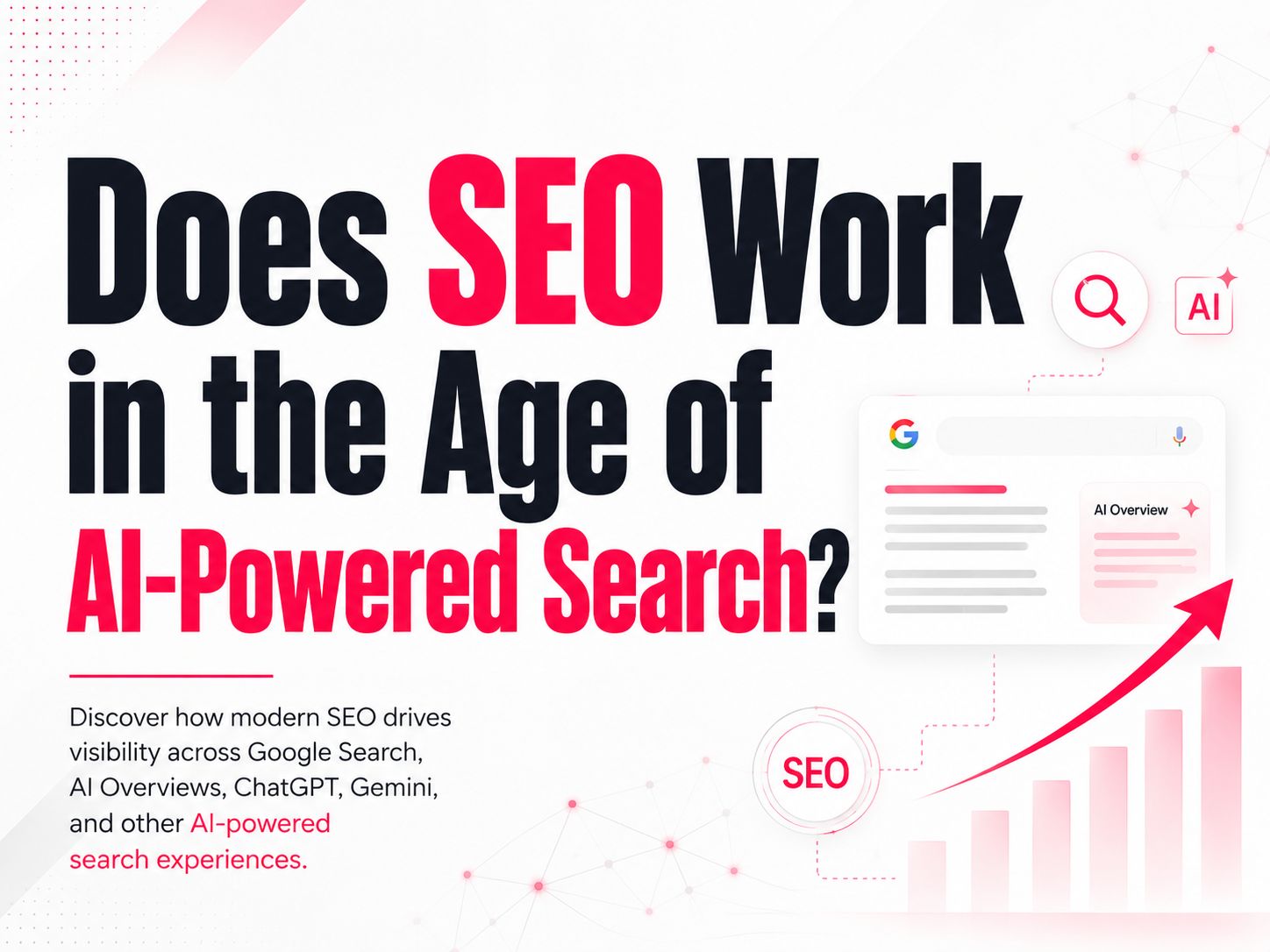
Does SEO Work in the Age of AI-Powered Search?
- June 29, 2026
Introduction
SEO still works in 2026. But it works differently, and the gap between adapting and ignoring the shift is widening fast. If your organic traffic is down, it is probably not because SEO stopped working. It is because the type of SEO you are doing no longer matches how Google and AI-powered search tools are delivering answers.
This post cuts through the noise with real data from the past 12 months and shows you what is actually changing, what is holding steady, and what to do next.
What the 2026 Data Actually Shows
AI Overviews are reducing organic click-through rates significantly, but they are not killing search overall. The picture is more specific than that.
Ahrefs analyzed 300,000 keywords of Google Search Console data and found that when an AI Overview appears, the click-through rate for the top-ranking page drops 58%. That is a major hit for anyone relying on informational content to drive traffic. Ahrefs
But here is the context most coverage skips: U.S. organic search traffic was down just 2.5% year over year as of January 2026. That is a real decline, not a catastrophe. What changed is where the value lands, not whether search still generates it. The Digital Bloom
A 21.9-million-search study found that 25.11% of Google searches triggered an AI Overview in Q1 2026. BrightEdge’s 12-month analysis from February 2025 to February 2026 found that AI Overviews now trigger on 48% of all tracked search queries, a 58% increase year over year. So the feature is expanding fast, but it still does not appear on the majority of queries. ContentlyInfinitelabsdigital
Google still accounts for more than 90% of global search activity. AI platforms such as ChatGPT and Perplexity collectively drive less than 1% of total referral traffic across the web. The new platforms are growing, but traditional search still dominates discovery. Smith Digital
Which Content Gets Hit Hardest by AI Overviews
Not all pages are equally exposed. The impact depends almost entirely on what type of queries your content targets.
Informational queries see an 80 to 88% AI Overview trigger rate depending on industry. E-commerce queries trigger AI Overviews only 4% of the time. That split is the single most important data point for content strategy right now.
If your site runs mostly “how to” and “what is” blog posts, you are in the highest-risk category. Your traffic is not going to a competitor. It is going to an AI-generated summary box that answers the query before a user ever sees your result.
Informational queries saw 30 to 40% organic traffic declines as AI Overviews handle these query types best. Transactional pages, pricing pages, and service pages are far less exposed. Velacore
The practical takeaway: if your SEO strategy was built around informational content to funnel readers toward a product or service, that funnel has a hole in the top. You need to either plug it by getting cited inside AI Overviews, or shift more effort toward commercial and transactional pages where AI Overviews rarely appear.
What SEO Signals Still Work (and Work Harder Now)
The core of good SEO did not change. What changed is the bar.
Google and AI tools both evaluate content using E-E-A-T signals: Experience, Expertise, Authority, and Trust. Author credentials, published citations, and update frequency all feed into that score. Nextnw
Structured data is now one of the most actionable technical moves available. Content using proper structured data sees 73% higher AI selection rates than content without it. If you have not added JSON-LD schema to your key pages, that is the single highest-ROI fix you can make today.
Freshness matters more than before. Pages not updated in 90 or more days are 3x more likely to lose AI citations, and more than 70% of pages cited by AI were updated within the last 12 months.
Brand search volume is now a meaningful AI citation signal. Brand search volume is the single strongest predictor of AI citation, with a correlation of 0.334, which outranks even backlinks as a signal. AI systems tend to cite brands people already search for. That means awareness campaigns and PR are no longer separate from SEO strategy. They feed it directly.
Backlinks still matter for traditional rankings, but their relationship to AI visibility is weaker. AI models favor semantic clarity and structured information over traditional authority signals like links. Concord
The New Game: Optimizing for AI Citations
Getting cited inside an AI Overview is now more valuable than ranking in position one for informational queries, because it protects and amplifies traffic at the same time.
Brands cited in AI Overviews earn 35% more organic clicks and 91% more paid clicks than non-cited brands for the same queries. Being inside the AI summary is not a consolation prize. It is the upgrade. Dataslayer
The overlap between top-10 Google rankings and AI Overview citations has collapsed from 75% in mid-2025 to between 17% and 38% by early 2026. That means ranking well in traditional search no longer guarantees you show up in AI-generated answers. You have to optimize for both separately. Mersel AI
What earns AI citations:
- Direct answers at the top of each section. AI systems extract the first clear, self-contained statement under a heading. If your section opens with context and caveats before the actual answer, the AI skips your content for a source that answers first.
- Original data, case studies, or specific numbers. Clients who shifted to cite-worthy content focused on case studies and original data gained visibility despite increased AI Overview presence. Generic how-to posts get summarized away. Pages with data the AI cannot find elsewhere get cited.
- Multi-format content. Pages combining text, images, video, and structured data earn 156% higher AI selection rates than text-only pages.
- Regular updates. Build a quarterly refresh cycle for your highest-traffic pages. Updating existing content outperforms publishing new posts for AI visibility right now.
The Brands Winning Right Now Are Doing This
The clearest pattern in 2026 SEO data is this: volume strategies are collapsing, authority strategies are accelerating.
Teams that use AI to assist with content production but keep a human review process in place are seeing better results. Validate facts, remove filler, and ensure every piece serves a real user need. Use AI to accelerate research and drafts, not to publish at scale without accountability.
Successful marketers are focusing on brand visibility across the web, aligning with topical authority by creating comprehensive, authoritative content that AI can confidently cite, and diversifying beyond traditional search through digital PR, content partnerships, and expert commentary.
There is also a channel shift worth watching. LinkedIn is currently the most-cited domain for professional queries across Google AI Overviews, ChatGPT, Microsoft Copilot, and Perplexity. For B2B brands, native LinkedIn content may currently be a higher-leverage citation asset than blog content on your own domain. Emarketed
AI-referred traffic converts at 14.2% versus Google’s 2.8%. The volume is smaller, but the visitors arrive informed and further along in their buying decision. Optimizing for AI citations is not just about protecting existing traffic. It is about acquiring higher-quality traffic from a channel that is growing fast.
Conclusion
SEO works in 2026, but not in the same way it did in 2022. The “publish more content” playbook is breaking because AI Overviews are absorbing clicks for the informational queries that strategy depended on. What is growing is authority. Brands that earn AI citations, build genuine topical expertise, use structured data, and keep their content current are gaining visibility even as generic SEO content loses it. The shift is real and it is permanent. The opportunity is still there for the brands willing to change what they optimize for.
Frequently Asked Questions (FAQs)
No. SEO is not dead, but parts of it need to change. Informational blog content built purely for organic traffic is under significant pressure from AI Overviews. Technical SEO, E-E-A-T, brand authority, and structured data are all working harder than before, not less. The brands struggling are those running volume-based content strategies. The brands growing are those building topical authority and earning AI citations.
Yes, but the relationship between ranking and traffic has weakened for informational queries. For transactional and commercial queries, AI Overviews rarely appear, so traditional rankings still drive clicks directly. For informational queries, the goal is no longer just ranking in the top 10. It is getting cited inside the AI Overview itself, which now comes from outside the top 100 organic results for a majority of citations.
Write content that answers questions directly at the start of each section, use proper structured data markup (especially FAQ and Article schema), keep pages updated at least quarterly, include original data or documented case studies, and build brand search volume through PR and awareness campaigns. These are the signals that correlate most strongly with AI citation, based on current research from BrightEdge, Seer Interactive, and AirOps.
Not entirely, but the strategy needs to shift. Thin how-to posts covering topics that AI can summarize in one sentence have very low ceiling now. Informational content that includes original research, expert perspective, documented experience, or specific data the AI cannot generate on its own still earns citations and traffic. Write less, go deeper, update regularly.
Share
Article by

Mehedi Hasan Juwel
Digital Marketing Strategist