AI-Powered Digital Marketing in Bangladesh
- May 13, 2026
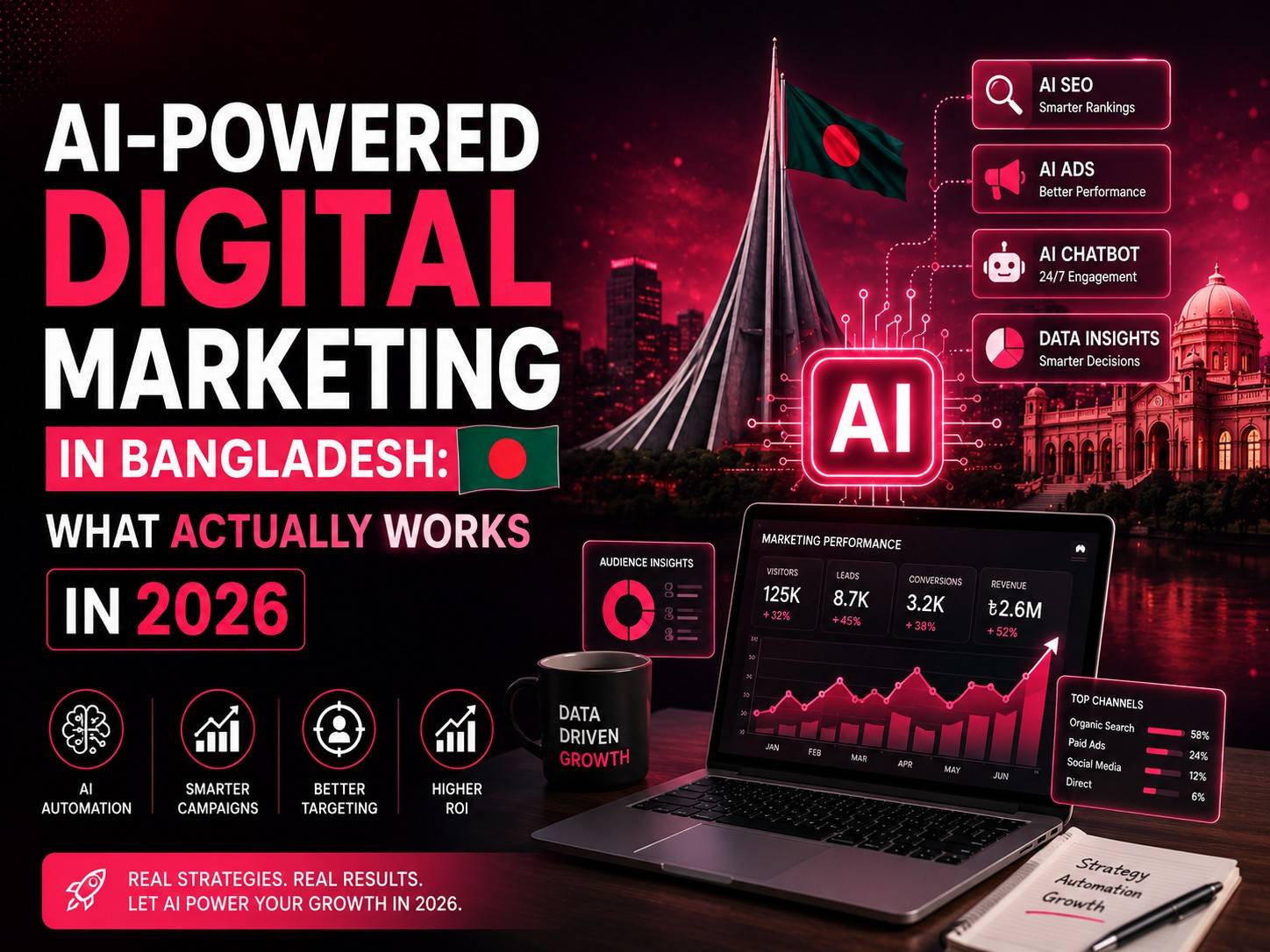
AI-Powered Digital Marketing in Bangladesh: What Actually Works in 2026
Digital marketing in Bangladesh has changed a lot over the past few years, and AI is a big reason why. Businesses now use it for SEO, ad targeting, content creation, and customer service — work that used to eat up hours of manual effort.
This isn’t limited to large companies anymore. Startups and small businesses have access to tools that were out of reach just a few years ago. That opens up real possibilities, but it also creates confusion. “AI marketing” gets thrown around to mean everything from chatbots to automated bidding to ChatGPT blog drafts. It helps to get specific.
What AI Marketing Actually Means in Practice
At its core, it means software that can process data and make decisions faster than humans. In Bangladesh, that shows up most visibly as Facebook and Google Ads targeting driven by machine learning, chatbots handling customer queries overnight, AI-assisted product descriptions, and predictive sales analytics.
Most of these don’t require a big team or technical background to use. That’s new.
Why It's Growing Here
Bangladesh has a fast-growing online audience. More people search on smartphones, shop through apps, and use voice search than they did three years ago. More online activity means more competition — and more reason to optimize.
Local brands are chasing SEO rankings, running Google Ads, and investing in content. When everyone is doing the same thing, speed and efficiency start to matter. AI tools help businesses move faster and spend smarter. The cost barrier has also dropped — ChatGPT, Surfer SEO, Canva AI — many have plans that fit a startup budget.
Where AI Actually Helps
SEO is one of the clearer wins. AI tools speed up keyword research, flag technical issues, and surface content gaps based on competitor data. For local businesses in Bangladesh, that means finding not just “AI SEO services Bangladesh” but more specific queries — “affordable SEO for small businesses Dhaka,” “voice search optimization for service companies.” Those longer queries often bring better-qualified traffic.
Google Ads has had machine learning built in for years. Third-party AI tools layer on top — testing ad copy, predicting conversions, flagging wasted budget. Useful, but it still requires someone who knows what they’re doing to set it up.
Content is trickier. AI drafts outlines, FAQs, meta descriptions, and internal link suggestions quickly. The problem is that unedited AI content often performs badly — Google’s quality guidelines reward accuracy and real expertise. Drafts need a human pass. Skipping that step is the most common mistake businesses make.
Chatbots handle the repetitive queries well: order status, appointment bookings, basic product questions. Not perfect, but they free up the team for conversations that actually need a person.
AI SEO vs. Traditional SEO
The fundamentals haven’t changed. Google still rewards relevant, accurate, well-structured content. What’s changed is how fast you can get there.
Manual keyword research was slow. AI compresses that process. Technical audits that took days now take minutes. But AI can’t replace a strategist. It can tell you what to target — it can’t tell you what your brand actually stands for or how to build trust with a specific audience. The SEO professionals who use AI as a tool, not a replacement for judgment, get better results than those who use either alone.
Tools Worth Knowing
ChatGPT for content drafts, ad copy, FAQs, and emails. Surfer SEO for on-page optimization and content scoring. Ahrefs for keyword research, backlinks, and competitor tracking. SEMrush for full SEO and PPC research. Canva AI for social graphics. Jasper for marketing copy.
Which ones are worth paying for depends entirely on what you’re trying to do. A business focused on content has different needs than one running paid ads.
The Real Problems
There’s a skills gap. Many businesses have adopted AI tools without understanding the strategy behind them. Published AI content with no editing, automated ads with poor audience setup, chatbots with no fallback — common mistakes, all of them costly.
Data privacy is also a real concern. AI personalization depends on customer data, and how that data is collected and used is increasingly scrutinized. Businesses need to think about that before scaling tracking and analytics.
Automation can also flatten what makes a brand interesting. If everything is AI-generated and nobody is steering, the output trends generic. Strong brands still need people making creative decisions.
What's Coming
Generative Engine Optimization is worth paying attention to. People increasingly get answers directly from AI tools — ChatGPT, Google AI Overviews, Perplexity — rather than clicking through search results. If your content doesn’t surface in those AI-generated answers, you’re invisible to a growing chunk of searchers.
AI video tools now assist with scripts, voiceovers, captions, and editing, which cuts production time considerably. Short-form video keeps growing, and the barrier to making it is dropping.
Hyper-targeted advertising is getting sharper too. AI can build very specific audience segments based on behavior and purchase patterns. But it requires clean data. Feed it garbage, get garbage back.
Choosing an Agency
Ask them directly: what AI tools do you use, where does the human work happen, and how do you measure results? Agencies that can’t answer clearly probably haven’t thought it through.
Watch out for fully automated campaigns with no human review, and reports that show activity without showing outcomes.
The Bottom Line
AI-powered marketing isn’t a shortcut. The businesses seeing real results are using AI to move faster and make smarter decisions — not to avoid doing the work.
Strategy, content quality, and knowing your audience matter as much as they ever did. AI changes how efficiently you execute on those things. That’s the actual value.
Conclusion
A digital marketing consultant can help your business grow faster with targeted online strategies. Whether you’re a startup or an established brand, hiring an expert gives you a clear marketing direction, measurable results, and better use of your budget.
If you are in Bangladesh, finding a qualified consultant is easier than ever. Review their experience, ask about performance metrics, and choose someone who communicates clearly. With the right partnership, you can build stronger online visibility and consistent growth.
Frequently Asked Questions (FAQs)
Using artificial intelligence tools to automate and improve SEO, advertising, content, and customer engagement. Everything from smart bidding in Google Ads to chatbots to AI-assisted content.
It speeds up keyword research, flags technical issues, surfaces content gaps, and suggests internal linking. It doesn't replace strategy.
Less than it used to be. Many tools have affordable plans for startups and small businesses.
No. It handles repetitive tasks well. Strategy, creative judgment, and brand decisions still need people.
Voice queries are more conversational and usually longer. Optimizing for them means writing how people actually talk, not just how they type.
Generative Engine Optimization — optimizing your content to appear in AI-generated search answers, not just traditional search results.
Share
Article by

Mehedi Hasan Juwel
Digital Marketing Strategist, SEO Expert & WordPress Developer